🏛️ Private Tour · Egyptologist Guide · No Shopping Stops
Ramesseum Temple Tour from Hurghada Explore Ancient Luxor
📅 Updated: June 2026 |
⏱️ 17 min read |
💶 From €95 / person |
⭐ 4.9/5 rated |
🏛️ West Bank Full Day Included
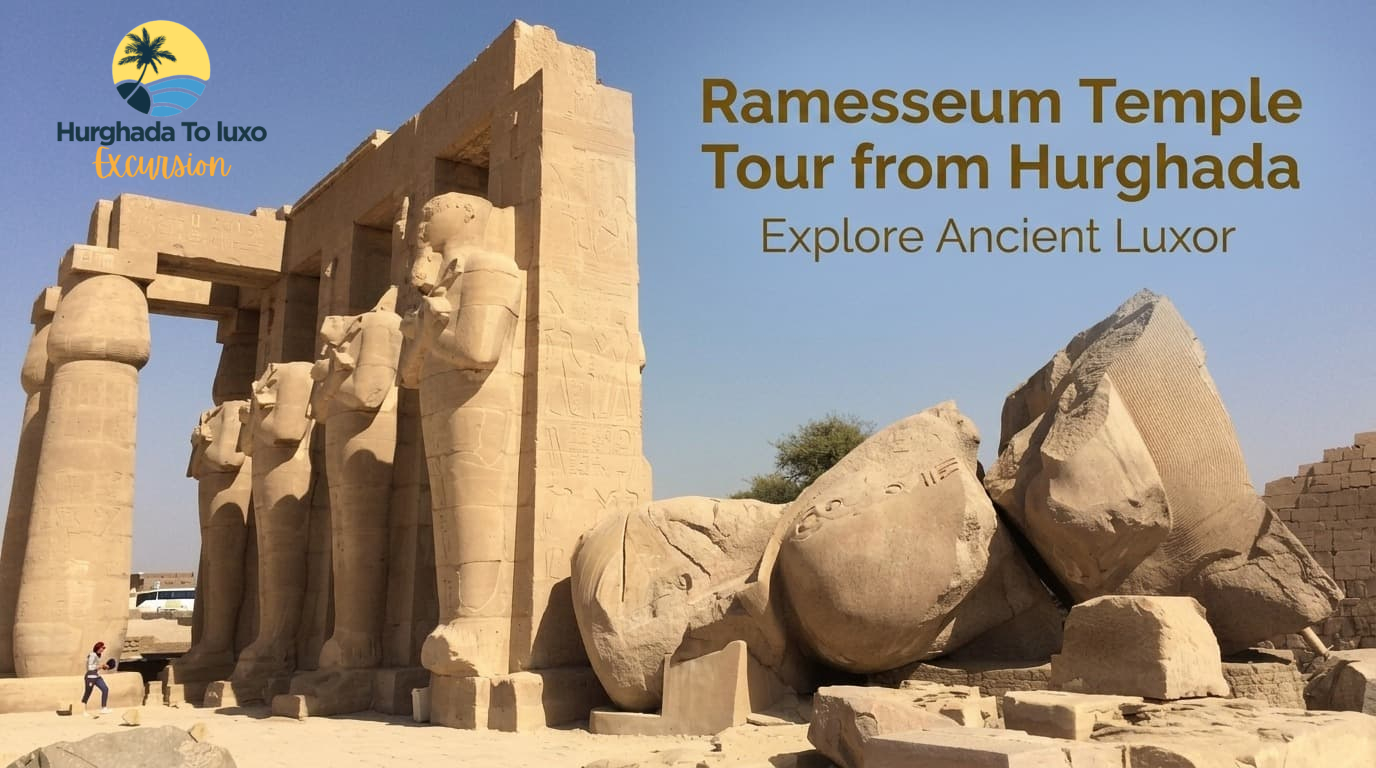
The Ramesseum Temple tour from Hurghada takes you to one of the most dramatic and poetic ancient sites in Egypt — the mortuary temple of Ramesses II, the pharaoh who ruled Egypt for 67 years and built more monuments than any other ruler in history. Standing before the Ramesseum’s shattered colossus — the fallen titan that inspired Percy Bysshe Shelley’s immortal poem Ozymandias — is one of the great philosophical moments available to any traveller in the ancient world.
This guide answers every question UK and international travellers ask before visiting: Is the Ramesseum worth visiting? Is it worth going to Luxor from Hurghada? Can you do a day trip from Hurghada to Luxor? And what about Abu Simbel — can you visit it from Luxor on the same trip? Whether you are planning your first Luxor excursion or returning to explore the West Bank in greater depth, this is the most comprehensive resource on the Ramesseum and West Bank Luxor available in 2026.
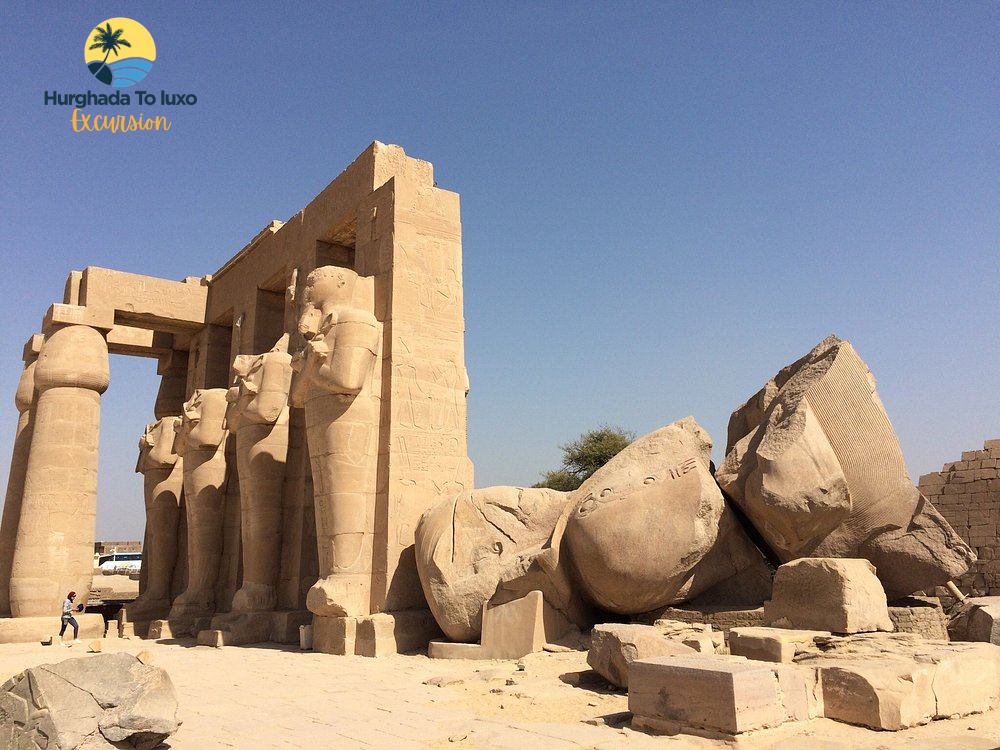
🏛️ Why the Ramesseum is unlike any other temple in Egypt: Most Egyptian temples have survived intact enough to overpower with scale and decoration. The Ramesseum is different — it is a ruin of extraordinary grandeur, where the fallen 1,000-tonne colossus of Ramesses II lies shattered across the floor of the second courtyard exactly as it fell, 3,200 years ago. Percy Shelley used it as the model for Ozymandias in 1818. Walking among these fragments with a dedicated Egyptologist guide is one of the most intellectually and emotionally resonant experiences ancient Egypt offers.
Is the Ramesseum Worth Visiting?
Yes — and it is one of the most underrated ancient sites on the entire West Bank. While Karnak and Luxor Temple attract the great majority of visitors, the Ramesseum sits quietly among the West Bank agricultural fields, visited by far fewer tourists and offering an experience that its more famous neighbours cannot replicate: the sight of genuine, monumental ancient ruin exactly as time and earthquake left it.
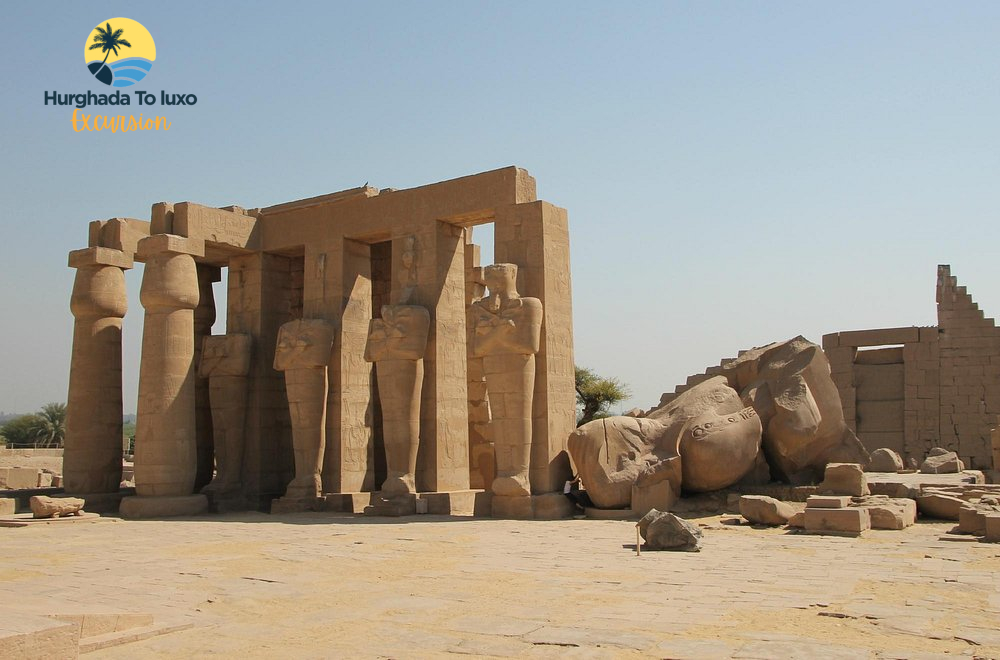
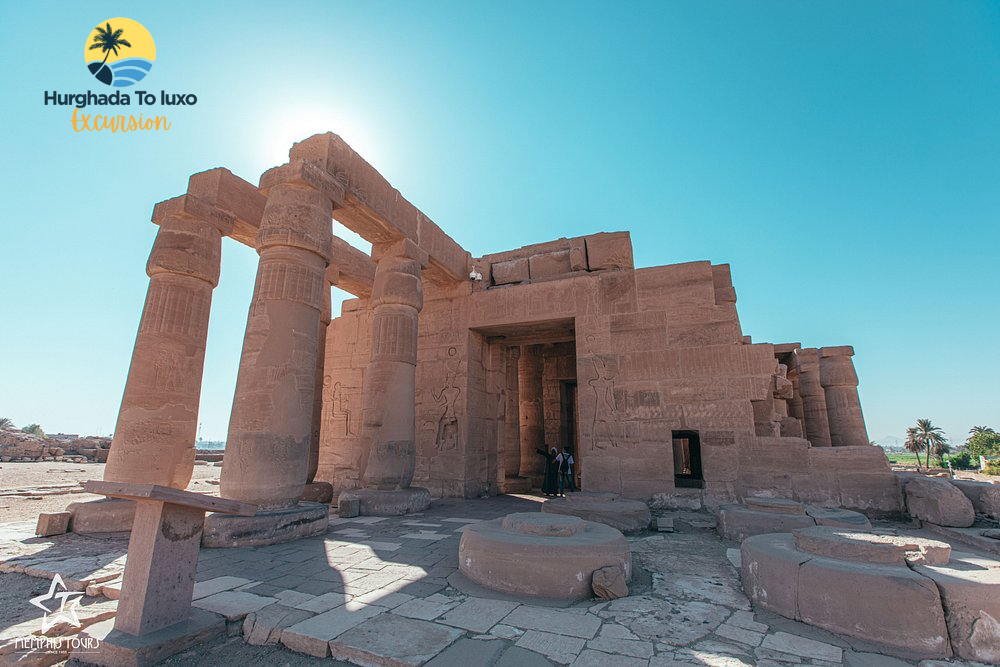
The Ramesseum is the mortuary temple of Ramesses II — the pharaoh known as Ramesses the Great, who ruled Egypt from 1279 to 1213 BCE and left more architectural monuments than any other pharaoh in history. The temple was described by the Greek historian Diodorus Siculus as the most magnificent in all of Egypt. Today it stands as a spectacular partial ruin — the first and second pylons collapsed, the great granite colossus of Ramesses shattered across the courtyard floor, the hypostyle hall still roofed with its original stone slabs decorated with astronomical paintings — a site of extraordinary atmosphere and philosophical weight.
5 Reasons the Ramesseum Is Worth Visiting
📜
The Ozymandias Connection
The shattered colossus of Ramesses II that lies in the second courtyard directly inspired Percy Shelley’s 1818 poem Ozymandias — one of the most famous poems in the English language. The inscription on its base once read: “I am Ozymandias, King of Kings — look on my works, ye mighty, and despair.” Standing before the fallen giant, the poem’s irony becomes physical and immediate.
🤫
Far Fewer Visitors
While the Valley of the Kings receives 5,000–8,000 visitors daily, the Ramesseum welcomes a fraction of that number. A private tour here gives you space to absorb the scale of the ruins without navigating crowds — the agricultural fields surrounding the temple add to the sense of peaceful, meditative exploration.
🌌
Astronomical Ceiling
The surviving sections of the hypostyle hall retain their original painted astronomical ceiling — one of the finest surviving examples of ancient Egyptian astronomy in any temple. The Ramesseum ceiling shows the Egyptian calendar, constellations, and planetary deities in vivid blue and gold. A sight impossible to appreciate on a standard rushed group tour.
⚔️
Battle of Kadesh Reliefs
The surviving walls of the Ramesseum carry some of the most detailed ancient military reliefs in Egypt — depicting Ramesses II’s famous Battle of Kadesh against the Hittites in 1274 BCE, the earliest recorded battle in world history. Your guide reads the hieroglyphic captions that name individual Hittite princes.
🔑 The honest answer: The Ramesseum is worth visiting for any traveller with a genuine interest in ancient Egypt — particularly for those who want to go beyond the standard tourist trail. It is not as intact as Karnak or as famous as the Valley of the Kings, but its atmosphere of magnificent ruin, its literary connections, and its extraordinary surviving decoration make it one of the West Bank’s most intellectually rewarding experiences. Combined with the Valley of the Kings, Hatshepsut Temple, and Colossi of Memnon in a single private day tour, it completes the full picture of royal Theban mortuary culture that no other combination of sites provides.
Is It Worth Going to Luxor from Hurghada?
Yes — Luxor is the single most rewarding excursion available from Hurghada, and it is not close. While Hurghada offers excellent Red Sea activities, the city’s proximity to the world’s greatest open-air museum — just 260 km across the desert — is one of the defining geographical advantages of any Egypt holiday based on the Red Sea coast. No other beach destination in the world puts you within 3 hours of sites like this.
Luxor was ancient Thebes — the capital of Egypt during the New Kingdom (1550–1070 BCE), the era of Egypt’s greatest power, wealth, and architectural achievement. The city contains a higher concentration of ancient monuments than anywhere else on earth: Karnak Temple, Luxor Temple, the Valley of the Kings, the Valley of the Queens, the Temple of Hatshepsut, the Ramesseum, Medinet Habu, and dozens of other temples and tombs spread across both banks of the Nile. One-third of all ancient Egyptian monuments are in Luxor.
| Question |
Answer |
| Drive distance |
260 km via Red Sea Mountains highway — approx. 3 hours each way |
| Is it worth it? |
Absolutely — most travellers call it the best day of their Egypt trip |
| Best format |
Private tour with dedicated Egyptologist guide — not group bus |
| How many days to see it properly? |
1 full day covers the main sites; 2 days for the complete experience |
| Is it accessible from any Hurghada hotel? |
Yes — we pick up from Hurghada, El Gouna, Sahl Hasheesh, Makadi Bay, Soma Bay |
Can You Do a Day Trip from Hurghada to Luxor?
Yes — a day trip from Hurghada to Luxor is entirely feasible and is one of the most popular excursions on Egypt’s Red Sea coast. Hundreds of travellers make the journey every single day of the year. The 260 km drive takes approximately 3 hours each way in a modern air-conditioned vehicle, leaving you 8–10 hours of sightseeing time in Luxor on a well-organised private tour.
The key to a successful Hurghada to Luxor day trip is departing early — ideally 05:00–06:00 AM — to arrive at the West Bank sites before the heat peaks and before the day’s group tour coaches arrive from Luxor’s Nile cruise ships. A private tour from Hurghada to Luxor with a dedicated Egyptologist gives you the flexibility to manage your time at each site properly rather than being rushed by a shared coach schedule.
✅ Private Tour Advantages
Dedicated Egyptologist guide all day. Private vehicle that waits for you alone. Zero shopping stops. Flexible schedule. Direct hotel pickup. The best possible format for Hurghada to Luxor.
⏰ Typical Day Timeline
05:30 AM departure → 08:30 AM Luxor arrival → 08:30 AM–17:00 PM sightseeing → 17:30 PM departure → 20:30 PM return to Hurghada hotel. A long but manageable and rewarding day.
🏛️ What You Can See
In a single day: Ramesseum, Valley of the Kings, Hatshepsut Temple, Colossi of Memnon (West Bank) + Karnak Temple or Luxor Temple (East Bank). A private guide makes this comfortable rather than rushed.
🌡️ Best Season
October–April is ideal (15–28°C). May and September are warm but manageable. June–August is very hot (38–44°C) but the sites are accessible — the Ramesseum has natural shade and the Valley tombs are naturally cool underground.
Can You Visit Abu Simbel from Luxor?
This is one of the most frequently asked questions from travellers combining Luxor and the Red Sea. The answer is: technically yes, but it requires an overnight stay in Aswan or a flight — it cannot be done as a same-day add-on to a Luxor excursion from Hurghada. Here is the complete picture.
Abu Simbel is located 280 km south of Aswan — approximately 900 km from Hurghada. Aswan is itself approximately 220 km south of Luxor. The logistics of combining the Ramesseum tour from Hurghada with an Abu Simbel visit in a single day are simply not viable without flying.
| Abu Simbel Option |
How It Works |
Feasibility from Hurghada |
| Fly Hurghada → Aswan → Abu Simbel (1 day) |
Flight HRG→ASW (1hr) + drive to Abu Simbel (3hr) + return flight |
✓ Feasible — no Luxor on same day |
| Luxor + Abu Simbel same day (car) |
Luxor (3hrs from HRG) + Aswan (3hrs further) + Abu Simbel (3hrs further) = 12hrs driving |
✕ Not feasible — too far |
| 2-Day Luxor + Aswan + Abu Simbel |
Day 1: Luxor (Ramesseum, West Bank). Day 2: Drive to Aswan + Abu Simbel. Overnight in Luxor or Aswan. |
✓ Excellent — best 2-day option |
| Fly Luxor → Aswan day trip |
Short flight from Luxor Airport to Aswan + 3hr drive to Abu Simbel and back |
✓ Possible if already overnight in Luxor |
💡 Our recommendation: If Abu Simbel is a priority for your Egypt trip, the ideal solution is our
2-Day Luxor + Aswan + Abu Simbel private tour — departing Hurghada, spending Day 1 at the Ramesseum and West Bank, overnighting in Luxor or Aswan, and visiting Abu Simbel on Day 2 before returning to Hurghada. Contact us at
[email protected] or WhatsApp +20 100 925 5585 to discuss this option.
10 Highlights of the Ramesseum Temple Tour from Hurghada
🗿
1. The Fallen Colossus of Ramesses II
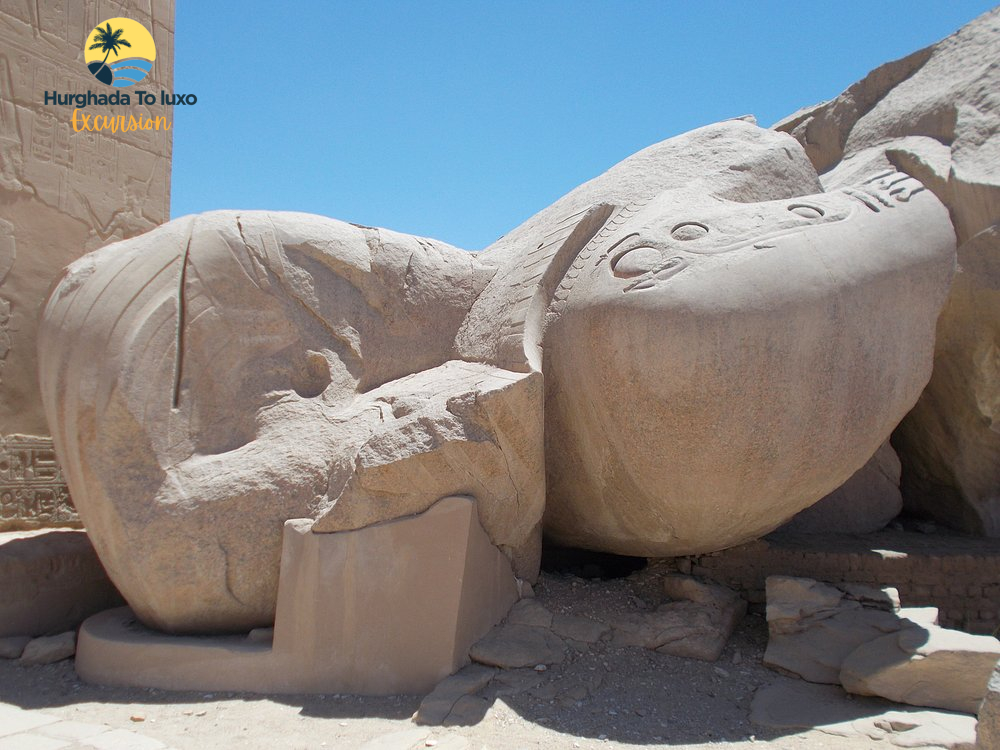
The shattered 1,000-tonne granite colossus that inspired Ozymandias — once the largest free-standing statue in Egypt at 17 metres and an estimated weight of 1,000 tonnes. It lies in massive fragments across the second courtyard floor exactly as it fell. The head alone is 2.7 metres wide. Nothing in Egypt conveys the grandeur and fragility of ancient power more immediately.
🌌
2. The Astronomical Ceiling
The hypostyle hall retains surviving sections of its original painted astronomical ceiling — deep blue decorated with golden stars, Egyptian calendar months, and the figures of constellations and planets. One of the finest surviving examples of ancient Egyptian astronomy still in situ.
⚔️
3. Battle of Kadesh Reliefs
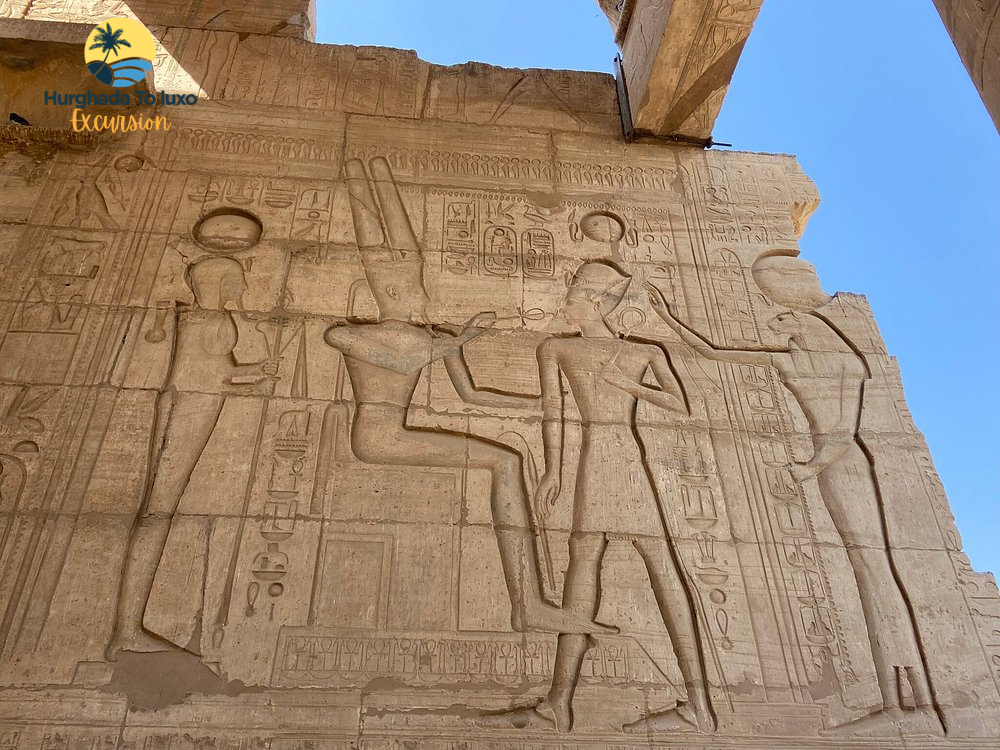
The outer walls of the Ramesseum carry some of the most detailed ancient military reliefs in Egypt — the Battle of Kadesh (1274 BCE) against the Hittites, the earliest recorded battle in world history. Ramesses charges alone in his chariot; the Hittite king watches from his fortress. Your guide reads the hieroglyphic captions identifying individual commanders.
🏛️
4. The Hypostyle Hall
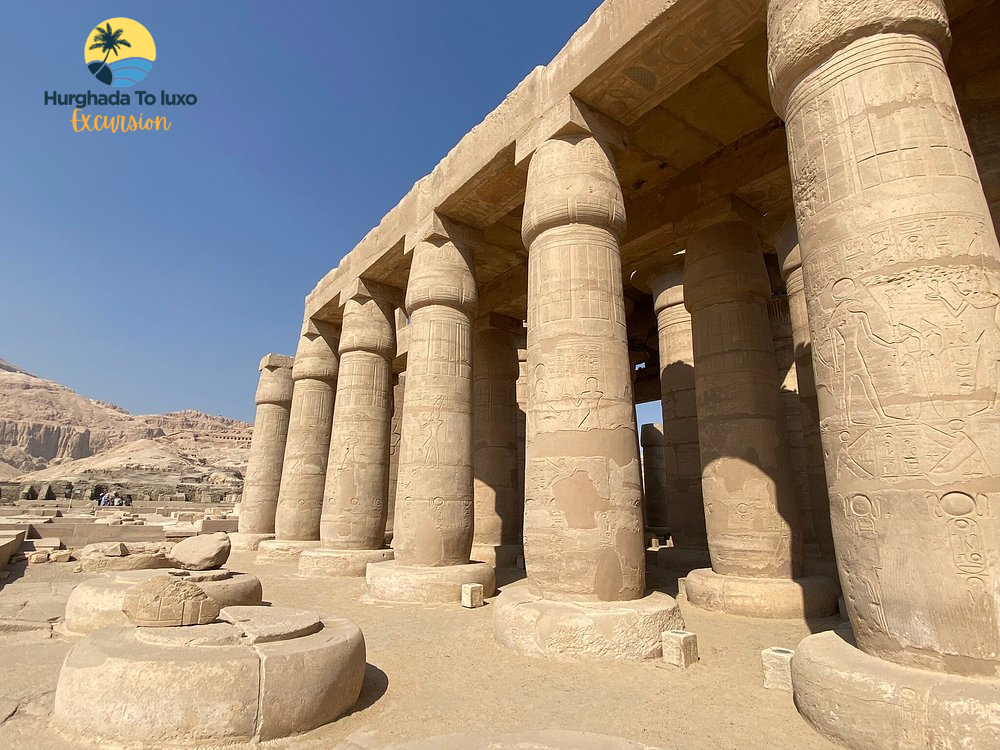
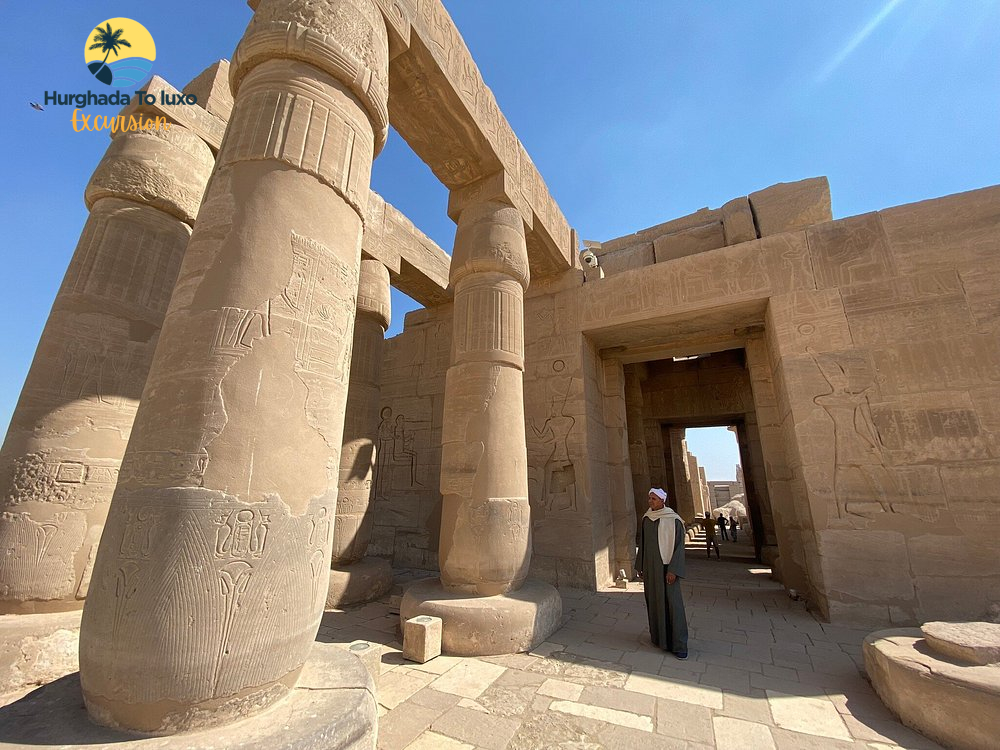
The second hypostyle hall — 48 papyrus columns in 3 rows, many still standing — is the best-preserved section of the temple and gives a powerful sense of the structure’s original scale and grandeur. The carved column capitals retain traces of original paint.
🌾
5. The Agricultural Setting
Unlike the Valley of the Kings (set in bare limestone) or Karnak (in the city), the Ramesseum sits among the West Bank’s green agricultural fields — farmland that has been cultivated since the pharaonic era. The juxtaposition of ancient ruins and living fields is one of the most atmospheric settings of any Egyptian site.
👑
6. Valley of the Kings
This tour combines the Ramesseum with the Valley of the Kings — 63 royal tombs, 3 included in your standard ticket, with the optional Tutankhamun tomb (~€15 extra). The morning visit before day-trippers arrive gives you the pharaonic tombs in the best possible conditions.
👸
7. Temple of Hatshepsut
The three-terraced mortuary temple of Egypt’s greatest female pharaoh — built almost exactly contemporaneously with the Ramesseum and in direct architectural contrast: where the Ramesseum overwhelms with scale, Hatshepsut’s temple elegantly integrates with the natural cliff formation behind it.
🗿
8. Colossi of Memnon
The twin 18-metre quartzite guardians of the West Bank — the first ancient monument you see after crossing the Nile, and the last as you leave. In antiquity they were famous for producing a musical sound at dawn as the stone warmed — the “singing Memnon” that attracted Roman tourists from across the empire.
🛥️
9. Private Nile Motorboat Crossing
The 10-minute motorboat crossing from Luxor’s East Bank to the West Bank is one of the great symbolic journeys in travel — the same crossing made by ancient Egyptians for 4,000 years on their way to bury their dead. Your guide explains its cosmological significance as you make it.
🍽️
10. Nile-View Lunch
A genuine mid-day rest at a quality Nile-view restaurant — included in your tour. Egyptian mezze, grilled dishes, fresh juices. Selected by your guide for quality, never commission. Vegetarian, halal, and child-friendly options always available.
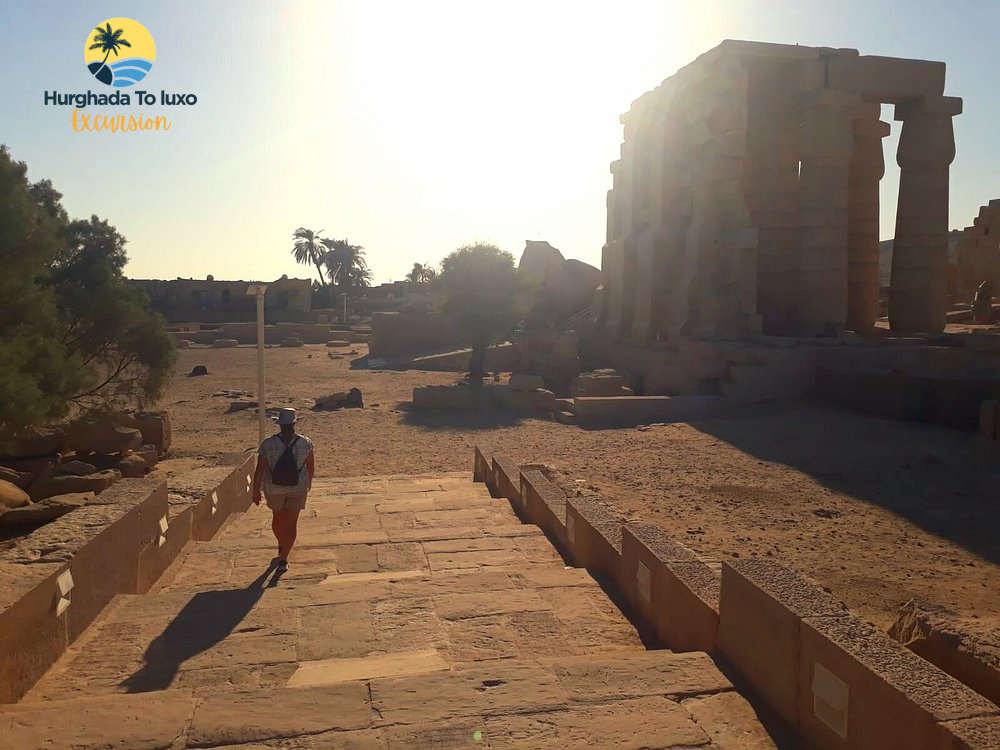
Full Itinerary — Hour by Hour from Hurghada
This is the complete Ramesseum Temple tour from Hurghada programme. Because this is a private tour, the itinerary is adjustable — tell us your priorities when booking and we tailor the day accordingly.
05
05:00 – 06:00 AM — Private Hotel Pickup
Your Private Vehicle Arrives at Your Hotel
Your private, fully air-conditioned vehicle collects you directly from your hotel lobby in Hurghada, El Gouna, Sahl Hasheesh, Makadi Bay, or Soma Bay. Pickup time is confirmed 24 hours in advance based on your hotel location. Bottled water and USB charging ports are provided from the first moment. The driver meets you in the lobby with a name board — no searching, no delays.
⛰️
05:30 – 08:30 AM — Hurghada to Luxor Transfer
The Desert Highway — Private Historical Briefing
The 260 km drive from Hurghada to Luxor crosses the Red Sea Mountains via the desert highway — approximately 3 hours. Your licensed Egyptologist guide travels with you from departure, using this journey for your private pre-visit historical briefing: the life and reign of Ramesses II, the construction of the Ramesseum, the Battle of Kadesh, the poem Ozymandias and its connection to the fallen colossus you will stand before. The desert sunrise over the Red Sea Mountains begins around 05:45 AM — one of the genuinely spectacular bonus experiences of the early departure.
🛥️
08:30 – 09:00 AM — Luxor Arrival & Nile Crossing
Crossing the Nile to the West Bank
You arrive in Luxor as the morning fully establishes itself. A private motorboat crossing of the Nile to the West Bank — the silver-blue water, the Theban Hills rising ahead, the East Bank city receding behind you. Your guide explains the ancient Egyptian cosmology of the Nile as a boundary between the world of the living and the world of the dead. Your private driver meets you on the western shore to begin the West Bank programme.
🗿
09:00 – 09:20 AM — Colossi of Memnon
The Ancient Guardians of the West Bank
The twin 18-metre quartzite colossi of Amenhotep III — first sight after the Nile crossing, standing in the open agricultural plain with the Theban cliffs behind them. In antiquity these were among the most famous monuments in the ancient world — Roman tourists travelled specifically to hear the “singing” sound the northern colossus produced at dawn as the stone warmed after the cold desert night. Your guide tells the complete story of the colossi and their context as the entrance pylons to the largest mortuary temple ever built in Egypt (now completely eroded). A 15-minute photography stop.
👑
09:20 – 11:30 AM — Valley of the Kings ⭐⭐⭐
The Royal Necropolis — Morning Visit Before the Crowds
The Valley of the Kings in the morning — arriving well before the peak of the day-trip coach parties from the Nile cruise ships. Your standard ticket includes 3 tombs selected by your guide based on which are open and best preserved on your visit date. The guide covers the complete history of the Valley — the decision to abandon pyramid-building, the role of the tomb-builders’ village of Deir el-Medina, the systematic ancient tomb robberies, and the extraordinary 1922 discovery of Tutankhamun’s intact tomb by Howard Carter. Optional: Tutankhamun’s tomb (~€15 extra, highly recommended). The full Ramesses II connection is drawn here — Ramesses II is buried in KV7 in the Valley, making the morning’s Valley visit and the afternoon’s Ramesseum visit two halves of the same story of Egypt’s greatest pharaoh.
👸
11:30 AM – 12:30 PM — Temple of Hatshepsut
Deir el-Bahari — Architectural Masterpiece of the West Bank
Between the Valley of the Kings and the Ramesseum stands the mortuary temple of Hatshepsut — the pharaoh who ruled Egypt for 21 years as king and built one of the most architecturally sophisticated temples in the ancient world. Three dramatic colonnaded terraces rise against the sheer limestone face of the Theban cliffs. The narrative reliefs — Hatshepsut’s divine birth, her trade expedition to Punt, her obelisk erection at Karnak — are among the finest in Egypt. Your guide draws direct comparisons between Hatshepsut’s elegant architectural language and the overwhelming scale of the nearby Ramesseum, built by her successor’s successor. The contrast tells the story of two radically different visions of royal power.
🏛️
12:30 – 14:00 PM — The Ramesseum ⭐⭐⭐
The Mortuary Temple of Ramesses the Great — Ozymandias in Stone
The centrepiece of the afternoon — and the site that makes this tour unlike any other Hurghada to Luxor excursion. The Ramesseum is the mortuary temple Ramesses II built for his own eternal worship, completed around 1255 BCE. The programme covers: the First Pylon (largely collapsed, its massive walls bearing reliefs of the Battle of Kadesh); the First Court (where the shattered granite colossus lies in pieces across the floor — the Ozymandias colossus, which Shelley read about in Diodorus Siculus and used as the basis for his 1818 poem); the Second Court and the standing colossus of Ramesses as Osiris; the second hypostyle hall with its 48 papyrus columns and surviving astronomical ceiling; the inner sanctuary areas and the small Amun temple to the north. Your guide reads the Ozymandias poem in situ beside the fallen colossus and explains the full literary and historical context. One of the most memorable guide performances available on any Egypt tour.
🍽️
14:00 – 15:30 PM — Nile-View Lunch
Rest, Eat, and Reflect
Lunch at a quality Nile-view restaurant after an extraordinary West Bank morning. Egyptian mezze, grilled fish and chicken, fresh salads and juices — selected by your guide for quality, never commission. Vegetarian, halal, and child-friendly options always available. The West Bank cliffs are visible across the water, the Theban hills golden in the afternoon sun. A genuine rest before the optional East Bank additions.
🏛️
15:30 – 17:00 PM — Optional: Karnak or Luxor Temple
East Bank — Complete the Full Picture of Ancient Thebes
For those with remaining energy, the East Bank is a 10-minute drive from the lunch restaurant. Karnak Temple at 15:30 is significantly quieter than the morning rush — a 60–90 minute visit covering the Great Hypostyle Hall, the Sacred Lake, and the Avenue of Ram-Headed Sphinxes. Alternatively, Luxor Temple (~90 minutes) in the afternoon light gives you the full East Bank picture. Either option connects the mortuary temples of the West Bank to the living temples of the East Bank and completes the ancient Theban geography. This add-on costs approximately €10 extra per person for the entrance ticket.
🚗
17:30 – 20:30 PM — Private Return to Hurghada
Door-to-Door Return as the Desert Turns Gold
Your private vehicle departs Luxor and drives directly to your Hurghada hotel — no shared stops, no coach schedule, no waiting. The 3-hour return drive crosses the Red Sea Mountains at sunset, the desert turning amber and copper. You arrive back at your hotel at approximately 20:30–21:00 with a full evening ahead. Bottled water and charging ports throughout.
Private Tours Only — Your Group, Your Schedule
Secure your Ramesseum Temple tour from Hurghada. Private vehicle, licensed Egyptologist guide, full West Bank programme. Zero shopping stops guaranteed.
🏛️ Book Ramesseum Tour — From €95
Free cancellation up to 24 hours before departure
Ramesseum Temple — Complete Visitor Guide
The Ramesseum was built by Ramesses II between approximately 1279 and 1213 BCE as his mortuary temple — the place where his divine essence would be worshipped for eternity after his death. Built in the great tradition of New Kingdom mortuary temples, it was designed to impress through sheer scale: the original complex covered over 20,000 m² and contained not only the main temple but granaries, administrative buildings, a palace, and a small Amun temple, all enclosed within a massive mudbrick enclosure wall much of which still survives.
Key Areas of the Ramesseum — What to See
🏛️ First Pylon — Battle of Kadesh
The largely collapsed First Pylon once stood over 20 metres high. Its surviving sections carry some of the most detailed Kadesh battle reliefs in Egypt — Ramesses II charging in his chariot, the Hittite coalition army fording the Orontes River, the fallen enemy. Your guide identifies the key narrative moments in sequence.
🗿 First Court — The Fallen Colossus
The most famous feature of the entire Ramesseum — the shattered granite colossus of Ramesses II, originally 17 metres tall and weighing approximately 1,000 tonnes. It fell during an earthquake, probably in the 11th century BCE. The head alone is 2.7 metres wide. The inscription on the base partially reads: “I am Ozymandias, King of Kings.”
👑 Second Court — Osirid Pillars
The second court retains many of its Osirid pillars — square piers with standing statues of Ramesses II in his mummiform Osiris aspect, arms crossed over his chest holding the crook and flail. These are among the best-preserved statuary in the entire Ramesseum.
🌌 Hypostyle Hall — Astronomical Ceiling
The second hypostyle hall — 48 columns in 3 rows — is the best-preserved interior section. The surviving roof slabs retain their original astronomical ceiling painting: deep blue with golden stars, Egyptian calendar months, and the personifications of planets and constellations.
🌾 The Granaries
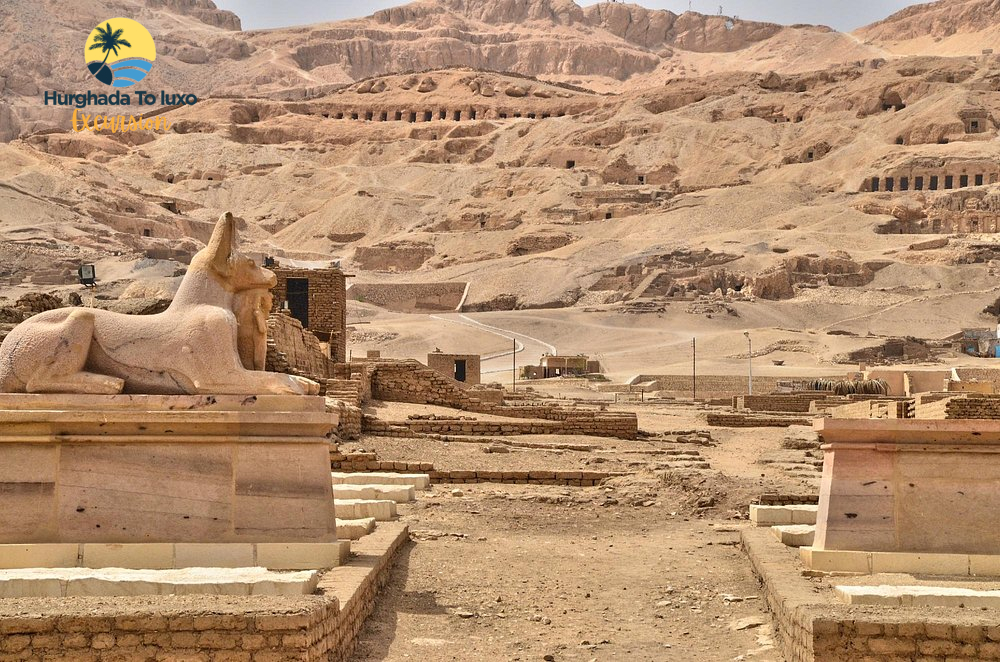
The extraordinary vaulted mudbrick granaries of the Ramesseum — part of the temple’s economic complex — survive in remarkably good condition and give a unique insight into the administrative and agricultural dimension of a major mortuary temple. The vaulted brick construction is among the most complete ancient Egyptian mudbrick architecture surviving.
📖 The Ozymandias Inscription
Your guide recites Shelley’s poem beside the fallen colossus — one of the most powerful literary moments available on any Egypt tour. The irony of the inscription (“Look on my works, ye Mighty, and despair”) is made viscerally real by the shattered stone around you. Diodorus Siculus recorded the original inscription in 60 BCE; Shelley read it in 1817 and wrote the sonnet the following year.
| Ramesseum Key Facts |
Detail |
| Built by |
Ramesses II (reigned 1279–1213 BCE) |
| Purpose |
Mortuary temple — cult worship of Ramesses II after death |
| Original colossus height |
~17 metres — approximately 1,000 tonnes of granite |
| Literary connection |
Percy Shelley’s Ozymandias (1818) — inspired by descriptions of the colossus |
| Modern visitor numbers |
Significantly fewer than Valley of the Kings — often quiet even at midday |
| Photography |
✓ Permitted throughout — no restrictions |
| Opening hours |
06:00 AM – 17:00 PM daily |
The Full West Bank Programme — Ancient Thebes Explored
The West Bank of Luxor is the most concentrated collection of ancient mortuary monuments on earth — a 12 km arc of temples, valleys, and tombs running from the Colossi of Memnon in the north to Medinet Habu in the south, with the Ramesseum roughly in the centre. Your private tour covers the essential programme of the West Bank in a single well-organised day.
| Site |
Time on This Tour |
Why It Matters |
Included? |
| Colossi of Memnon |
09:00–09:20 AM |
Ancient guardians of the West Bank — world-famous in Roman times |
✓ Yes |
| Valley of the Kings |
09:20–11:30 AM |
Royal necropolis of 63 pharaohs — Tutankhamun, Ramesses II, Seti I |
✓ Yes (3 tombs) |
| Temple of Hatshepsut |
11:30 AM–12:30 PM |
Egypt’s greatest female pharaoh — stunning 3-terraced cliff temple |
✓ Yes |
| The Ramesseum |
12:30–14:00 PM |
Mortuary temple of Ramesses II — fallen colossus, astronomical ceiling, Kadesh reliefs |
✓ Yes |
| Tutankhamun’s Tomb |
During Valley visit |
Only royal mummy still in the Valley — most famous tomb in Egyptology |
+€15 extra |
| Karnak or Luxor Temple |
15:30–17:00 PM |
World’s largest religious complex / East Bank processional temple |
+€10 extra (optional) |
2026 Pricing — Ramesseum Temple Tour from Hurghada
Starting from
€95
per adult · approx. £81 per person
✓ Private Vehicle · ✓ All Entrance Fees · ✓ Egyptologist Guide · ✓ Lunch · ✓ Nile Crossing
Children (0–12): €50 · Solo supplement: +25%
What Is Included
✓ Private round-trip air-conditioned vehicle (Hurghada ↔ Luxor) — your group only
✓ Licensed English-speaking Egyptologist guide — dedicated to your group all day
✓ Ramesseum Temple entrance
✓ Valley of the Kings entrance (3 standard tombs)
✓ Temple of Hatshepsut & Colossi of Memnon
✓ Nile motorboat crossing (West Bank)
✓ 1 lunch at a quality Nile-view restaurant
✓ Bottled water throughout the day
✓ Zero shopping stops — guaranteed
What Is Not Included
✕ Tutankhamun’s tomb (~€15 extra — highly recommended)
✕ Karnak or Luxor Temple add-on (~€10 extra per person — optional afternoon)
✕ Tips for guide and driver (optional — €10–€15 total appreciated)
✕ Personal purchases and souvenirs
What to Pack — Day Trip Checklist
🧴
Sun Protection
SPF 50 sunscreen, wide-brimmed hat, UV sunglasses. The Ramesseum sits in open farmland with limited shade. The Valley of the Kings plateau is fully exposed. Reapply every 90 minutes outdoors — Luxor UV is high year-round.
👟
Comfortable Walking Shoes
You will walk 6–10 km across the day on uneven stone, gravel, and agricultural paths. The Ramesseum has rough terrain between ruined sections. Closed-toe walking shoes or trainers only — no sandals or heels.
📷
Camera & Power Bank
The Ramesseum is one of the most photogenic sites on the West Bank — photography is permitted throughout (unlike the Valley of the Kings tombs). The fallen colossus and the standing columns with the Theban fields behind are extraordinary compositions. Bring a 20,000 mAh power bank for a full day.
👗
Modest Breathable Clothing
Shoulders and knees covered at temple sites (Hatshepsut, optional Karnak). Light cotton throughout the day. Women should carry a light scarf. Pale colours are significantly cooler than dark in Luxor’s summer sun.
💰
Cash in EGP
Egyptian pounds for Tutankhamun’s tomb extra ticket (~€15), tips, and purchases. Approximately £40–£50 equivalent covers all optional extras comfortably. June 2026: £1 ≈ 65 EGP. ATMs on the Luxor Corniche.
📚
Read Ozymandias First
Percy Shelley’s 14-line sonnet Ozymandias (1818) takes 60 seconds to read. Reading it before your visit — and again in front of the fallen colossus — transforms the Ramesseum from a ruin into one of the most powerful philosophical experiences available in any ancient monument anywhere in the world.
10 Insider Tips from Our Egyptologist Guides
Tip 1 — Ask your guide to read the Ozymandias poem at the fallen colossus. This is one of the most memorable guide moments available on any Egypt tour — standing beside the shattered 1,000-tonne granite head of Ramesses II while your Egyptologist recites Shelley’s sonnet. It requires a guide with the knowledge and instinct to do it properly. All our guides do this as standard. If yours does not suggest it, ask.
Tip 2 — The Ramesseum is best in the afternoon, not the morning. Unlike the Valley of the Kings (where morning is essential to beat the crowds), the Ramesseum receives far fewer visitors at any time of day. The afternoon light on the sandstone ruins and the agricultural fields behind them has a warm quality that morning light lacks. This tour’s scheduling — Ramesseum at 12:30–14:00 PM — is the optimal timing.
Tip 3 — Look up inside the hypostyle hall. The surviving astronomical ceiling sections are easily missed because most visitors focus on the floor-level colossus fragments. Step into the second hypostyle hall and look directly up — the deep blue ceiling with golden stars and calendar figures is one of the finest surviving painted ceilings in any Egyptian temple.
Tip 4 — Photography is permitted throughout the Ramesseum — use it. Unlike the Valley of the Kings tombs where all photography is prohibited, the Ramesseum allows cameras and phones throughout. The fallen colossus, the standing Osirid pillars, the hypostyle columns, the granary vaults, and the outer wall reliefs all photograph magnificently. Budget at least 30 minutes purely for photography.
Tip 5 — The granaries are not to be missed. Most first-time visitors focus entirely on the temple proper and walk past the vaulted mudbrick granaries on the temple’s northern side. These remarkably preserved structures — barrel-vaulted brick chambers that once stored grain for the temple economy — are among the most complete examples of ancient Egyptian mudbrick architecture surviving anywhere in Egypt. Your guide leads you through them.
Tip 6 — Compare the Ramesseum to Hatshepsut Temple deliberately. The two temples are built within decades of each other and represent entirely opposite architectural philosophies: the Ramesseum overwhelms through scale and military imagery; Hatshepsut’s temple harmonises with its natural setting and celebrates trade and divine legitimacy. Your guide draws this contrast explicitly — the comparison deepens your understanding of both sites significantly.
Tip 7 — KV7 — the tomb of Ramesses II himself — is in the Valley of the Kings. Ramesses II’s own tomb (KV7) is one of the largest in the Valley but is not currently open to visitors due to restoration work. Your guide will explain why — the tomb suffered severe water damage in antiquity and has been undergoing structural consolidation. Understanding that the pharaoh whose mortuary temple you are visiting is buried just 2 km away deepens the experience of both sites significantly.
Tip 8 — The Colossi of Memnon “singing” story is one of the great tourist tales of antiquity. The northern colossus famously produced a musical sound at dawn for several centuries — now believed to have been caused by the heating of water-saturated limestone after cold desert nights, creating vibrations as the stone expanded. Roman emperors and generals made pilgrimages to hear it. When the Roman emperor Septimius Severus repaired the cracked colossus in 199 CE, the singing stopped. Your guide tells the full story on site.
Tip 9 — The West Bank agricultural fields around the Ramesseum have been farmed since antiquity. The green fields between the Ramesseum and the Colossi of Memnon are irrigated from the same Nile water that ancient Egyptian farmers depended on. Walking from one site to the other through working farmland — past sugarcane, banana trees, and date palms — is one of the most genuine connections to ancient Egyptian daily life available on any Egyptian tour.
Tip 10 — Add Medinet Habu if time allows. Medinet Habu — the mortuary temple of Ramesses III, 1 km south of the Ramesseum — is one of the best-preserved large temples on the West Bank and contains extraordinary reliefs of the Sea Peoples invasion (1177 BCE). It is rarely included on standard tours and is another outstanding example of the way the private format allows you to go beyond the tourist circuit. Mention it at booking if you are interested and we build it into the schedule.
Real Reviews from Travellers
★★★★★
“The guide read Ozymandias out loud while we stood in front of the shattered colossus. I have read that poem a hundred times. Standing in front of the actual fallen head of Ramesses II while someone reads it to you — there are no words. The Ramesseum is not on most people’s Luxor list and it absolutely should be. Extraordinary tour, extraordinary guide.”
Philip & Sarah K. — London, UK · April 2026
★★★★★
“We had done a standard day trip to Luxor from Hurghada two years ago — Valley of the Kings and Karnak, rushed, one shopping stop. This private tour with the Ramesseum was completely different. Time at each site, no shopping, a guide who genuinely knew and loved the material. The Ramesseum’s astronomical ceiling is breathtaking and I would never have noticed it without the guide pointing it out.”
Emma & Tom R. — Bristol, UK · February 2026
★★★★★
“I am a teacher of classical history and I was sceptical that a tour guide could tell me much I didn’t know about ancient Egypt. I was completely wrong. Our guide connected the Battle of Kadesh reliefs on the Ramesseum walls to the actual text of the peace treaty between Ramesses and the Hittites — the oldest surviving peace treaty in history — and made the entire site come alive in a way I had never experienced. Worth every penny and more.”
Dr. Helen M. — Oxford, UK · March 2026
Frequently Asked Questions
Is the Ramesseum worth visiting?
Yes — the Ramesseum is one of the most atmospheric and underrated sites on the entire West Bank. It combines the most dramatic ruined architecture in Luxor (the fallen 1,000-tonne colossus of Ramesses II), some of the finest surviving military reliefs in Egypt (the Battle of Kadesh), an extraordinary astronomical ceiling in the hypostyle hall, and the famous literary connection to Percy Shelley’s poem Ozymandias. Visited with a dedicated Egyptologist guide, it is one of the most intellectually resonant experiences ancient Egypt offers.
Is it worth going to Luxor from Hurghada?
Yes — Luxor is the single most rewarding excursion available from Hurghada. The 260 km drive takes 3 hours each way but puts you at the world’s greatest concentration of ancient monuments. One-third of all ancient Egyptian monuments are in Luxor. Most travellers who visit Luxor from Hurghada call it the best day of their entire Egypt trip. The key is doing it properly: private tour, dedicated Egyptologist guide, early departure, no shopping stops.
Can you do a day trip from Hurghada to Luxor?
Yes — it is one of the most popular excursions from Hurghada. Departing at 05:00–06:00 AM, arriving in Luxor at 08:00–09:00 AM, and returning at approximately 17:30–18:00 gives you a full 8–9 hours of sightseeing. A private tour with a dedicated guide and private vehicle is the optimal format — it allows proper time at each site and eliminates the shopping stops and rushed scheduling of group bus tours.
Can you visit Abu Simbel from Luxor?
Abu Simbel is approximately 500 km south of Luxor — it cannot be visited as a same-day add-on to a Luxor excursion from Hurghada. The most practical options from Hurghada are: (1) a separate fly-drive day trip from Hurghada directly to Aswan + Abu Simbel; or (2) our 2-Day Luxor + Aswan + Abu Simbel private tour — Day 1 covers Luxor’s West Bank, Day 2 drives to Aswan and Abu Simbel before returning to Hurghada. Contact us at
[email protected] to discuss this option.
What is the connection between the Ramesseum and the poem Ozymandias?
Percy Shelley wrote Ozymandias in 1818 after reading Diodorus Siculus’s description of the great statue of Ramesses II at the Ramesseum, which he encountered in the Greek historian’s work. The famous inscription (“I am Ozymandias, King of Kings — look on my works, ye mighty, and despair”) was recorded by Diodorus as being on the base of the statue. When the fallen granite colossus at the Ramesseum was later examined, a partially preserved inscription was found on its base. Ozymandias is the Greek form of Ramesses II’s throne name — User-Maat-Ra. The poem remains one of the most widely read in the English language and standing before the shattered colossus that inspired it is one of the great literary-historical experiences in travel.
How much does the Ramesseum Temple tour from Hurghada cost?
From €95 per adult (approximately £81). Children aged 0–12 pay €50. Solo travellers subject to 25% single supplement. Included: private vehicle, Egyptologist guide, Ramesseum entrance, Valley of the Kings (3 tombs), Hatshepsut Temple, Colossi of Memnon, Nile crossing, lunch, and bottled water. Optional extras: Tutankhamun’s tomb (~€15), Karnak or Luxor Temple add-on (~€10). Zero shopping stops guaranteed.
Is photography allowed at the Ramesseum?
Yes — photography is permitted throughout the Ramesseum without any additional charge or restriction. This makes it a significant advantage over the Valley of the Kings, where all photography inside the tombs is strictly prohibited. The fallen colossus, the Osirid pillars, the hypostyle columns, the granary vaults, and the outer wall reliefs are all fully photographable. Bring your best wide-angle lens for the colossus fragments and the granary interiors.
Is the Ramesseum tour suitable for families with children?
Yes — the Ramesseum is excellent for families with children aged 8 and above. The open-air ruins are less claustrophobic than the Valley of the Kings tombs, photography is permitted throughout, and the sheer scale of the fallen colossus is immediately impressive to children of all ages. The guide uses age-appropriate storytelling to bring Ramesses II to life as a historical character. Children aged 0–12 pay €50. Child seats available on request at booking.
Book Your Ramesseum Temple Tour from Hurghada
Private vehicle, licensed Egyptologist guide, Ramesseum + Valley of the Kings + Hatshepsut Temple + Colossi of Memnon. Nile crossing, lunch, and bottled water included. Zero shopping stops guaranteed. Free cancellation 24 hours before departure.
🏛️ Book Now — From €95 Per Person
Final Thoughts — Why the Ramesseum Changes How You See Ancient Egypt
The Ramesseum is not the most intact temple in Luxor. It is not the most famous. But it is, arguably, the most powerful — because its state of magnificent ruin makes the passage of time physical in a way that well-preserved temples cannot. When you stand beside the shattered granite colossus of Ramesses II — the pharaoh who ruled Egypt for 67 years, built more monuments than any other king in history, and proclaimed himself the greatest ruler who ever lived — and read Shelley’s response to that claim, something shifts in your understanding of ancient civilisation that no perfectly preserved temple can produce.
A private Ramesseum Temple tour from Hurghada with a dedicated Egyptologist guide gives you the time, the knowledge, and the space to experience this fully. The West Bank of Luxor is the most important mortuary landscape in the ancient world — the Ramesseum is its most philosophically resonant monument. Book your tour today and explore ancient Luxor the way it deserves to be explored.