Private Abydos and Dendera Tour from Hurghada – Discover the magnificent temples of Abydos and Dendera, admire ancient Egyptian art, and enjoy a private guided tour from Hurghada. Book your unforgettable Egypt adventure today!
📅 Updated: June 2026 | ⏱️ 19 min read | 💶 Price on Request | ⭐ 5.0/5 rated | 🏛️ Dendera · Abydos · Temple of Hathor · Seti I Temple
The private Abydos and Dendera tour from Hurghada covers two of the most remarkable and least-visited ancient sites in Egypt — both located between Hurghada and Luxor in the middle Nile Valley, and both outstanding in ways that no other Egyptian temples replicate. Dendera’s Temple of Hathor is famous above all for its extraordinary painted astronomical ceiling — one of the most sophisticated surviving examples of ancient Egyptian scientific knowledge. Abydos’s Temple of Seti I contains the finest painted relief art in Egypt, and the adjacent Osireion carries one of the most profound religious narratives in the ancient world.
The route from Hurghada crosses the Eastern Desert, enters the Nile Valley near Qena, and visits both sites — Dendera first, then Abydos — before returning to Hurghada. Depending on the distance and desired pace, this tour is available as a long single day or with an optional overnight stay in Qena that allows a more relaxed programme without the late return drive. This guide covers the complete itinerary, what makes each site genuinely extraordinary, the optional overnight structure, full pricing information, and every practical detail before booking.
🌟 Why Dendera and Abydos are not on most standard itineraries: Both sites sit between Hurghada and Luxor — accessible from either end of the road, but typically skipped because they are not as famous as the Luxor or Aswan sites. This is their great advantage: on any given day, Dendera and Abydos receive a fraction of the visitors that crowd Karnak or the Valley of the Kings. Your guide can move through both temples at the appropriate pace, explaining the astronomical ceiling at Dendera and the painted corridors at Abydos with the depth they deserve, without the pressure of tour buses arriving and departing around you.
This is a private tour connecting Hurghada to two of Upper Egypt’s most archaeologically significant and least-crowded sites. The route crosses the Eastern Desert to the Nile Valley, visits Dendera Temple and then Abydos Temple in sequence, and returns to Hurghada — either in a single long day or with an optional overnight in the Qena area for a more relaxed pace.
Detail
Information
Tour Type
Private — your group only, no shared passengers
Format Options
Single-day round trip OR with optional Qena overnight
Route
Hurghada → Dendera Temple (Qena) → Abydos Temple of Seti I → Hurghada
Sites Visited
Temple of Hathor at Dendera · Temple of Seti I at Abydos · The Osireion
Distances
Hurghada → Dendera: ~230 km · Dendera → Abydos: ~80 km · Abydos → Hurghada: ~310 km
Guide
Licensed Egyptologist, dedicated to your group throughout
Departure Points
Hurghada, El Gouna, Sahl Hasheesh, Makadi Bay, Soma Bay
Price
Price on Request — contact us with group size, preferred dates, and format (day trip or overnight)
Dendera Temple — The Astronomical Ceiling of Hathor
The Temple of Hathor at Dendera is one of the most completely preserved ancient Egyptian temples in existence — and the one that contains, in its inner hypostyle hall ceiling, the most sophisticated surviving example of ancient Egyptian astronomical knowledge.
The Astronomical Ceiling
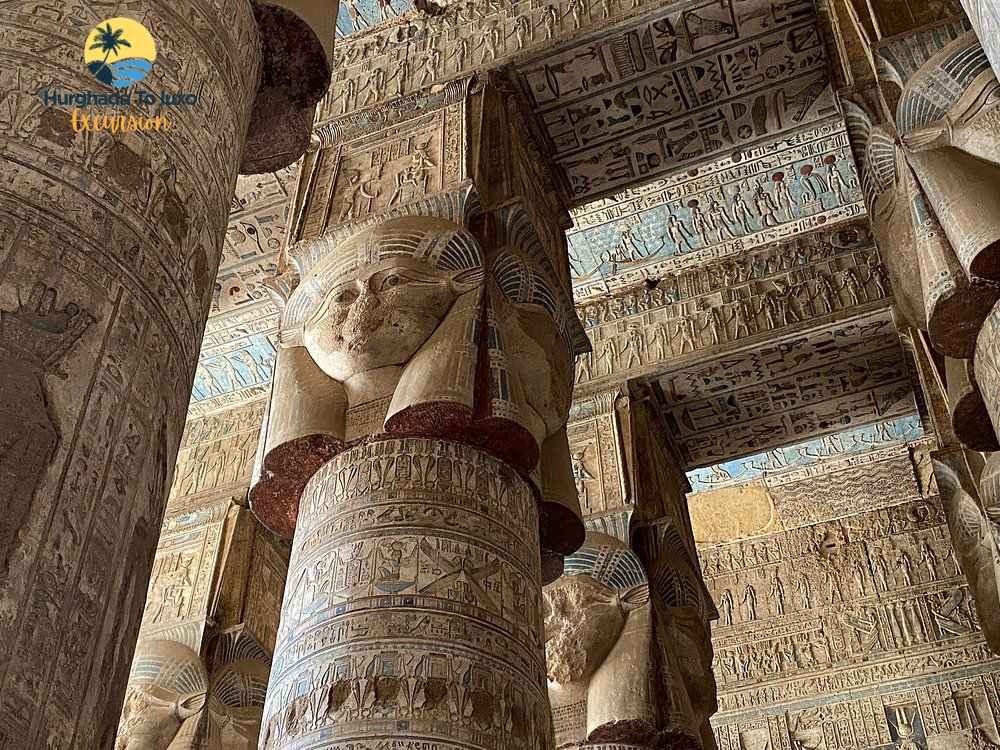
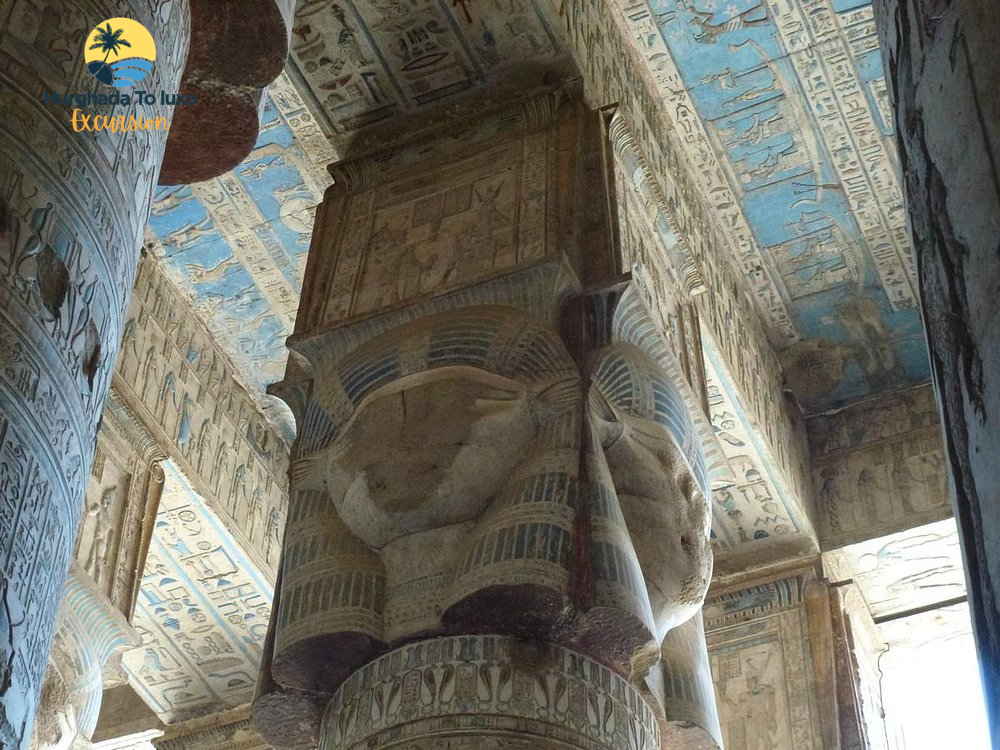
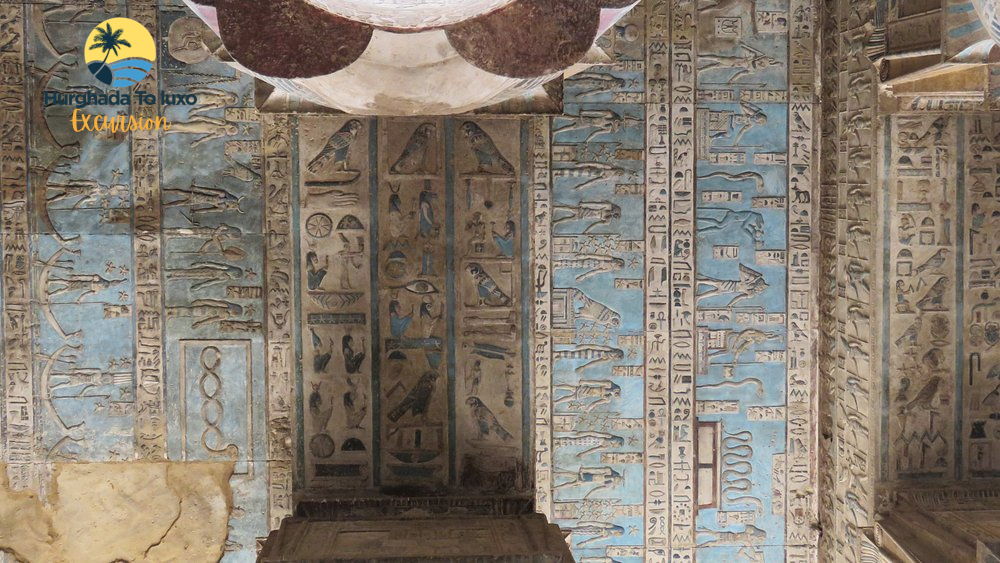
The ceiling of the Dendera Temple’s inner pronaos (vestibule) is covered in a painted astronomical programme that records the Egyptian understanding of the sky, the stars, and the calendar in one of the most dense and extraordinary carved-and-painted surfaces in Egyptian art. Its elements include:
The Dendera Zodiac
The original circular zodiac carved at Dendera — now in the Louvre in Paris, replaced on-site by a copy — is one of the earliest dated examples of a complete zodiac chart in ancient Egypt, incorporating Babylonian astronomical concepts alongside traditional Egyptian ones. Carved approximately 50 BCE.
The 36 Decans
The 36 decans — star groupings used in the Egyptian calendar to mark the passage of time through the night — are represented as deities across the ceiling’s full width, each rising on the eastern horizon for approximately 10 days before being replaced by the next.
The Annual Calendar
The 12 months of the Egyptian calendar, the seasonal stars, the planetary deities, and the goddesses Nut and Hathor depicted in their astronomical roles across the full breadth of the hall’s ceiling in preserved colours that remain among the most vivid in any Egyptian temple.
The Crypts
Dendera has a unique system of underground crypts accessible through narrow passages in the temple walls — repositories of sacred objects and ritual equipment where wall carvings were kept deliberately hidden from all but the highest-ranking priests. Electrically lit and accessible today.
Dendera in Context
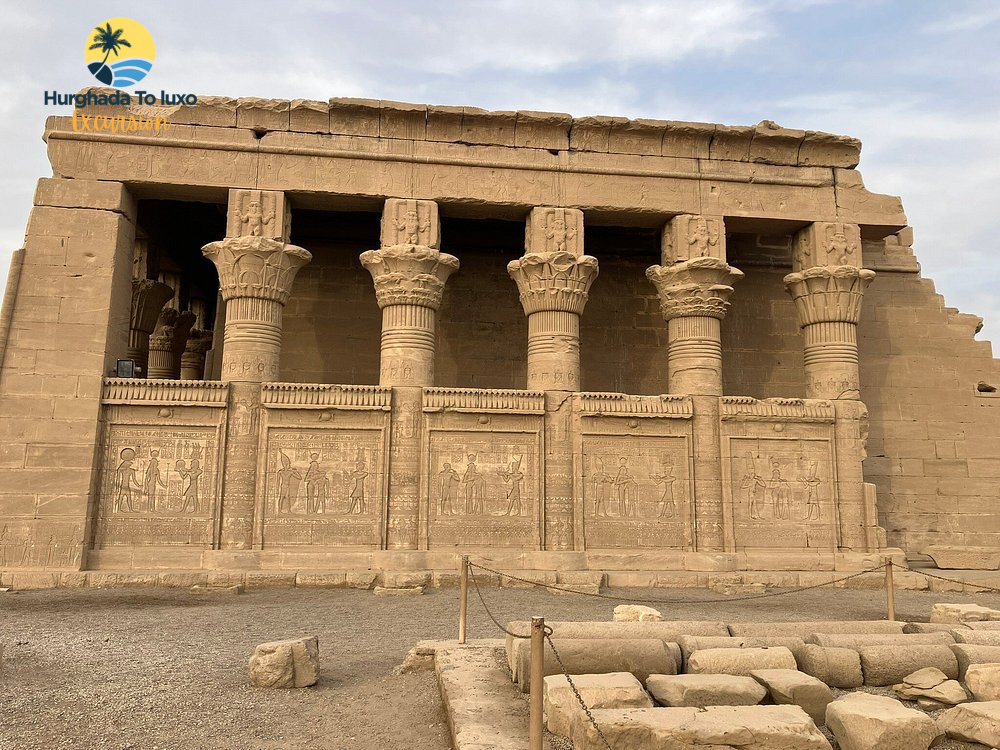
Like Edfu and Kom Ombo, Dendera is a Ptolemaic-era temple — built by the Greek-descended rulers who adopted Egyptian religion as a tool of legitimacy. Its remarkable state of preservation results from the same cause as Edfu’s: it was buried under accumulated debris and later construction for centuries, protecting its painted and carved surfaces from exposure. When Napoleon’s expedition documented it in the early 19th century, the ceiling’s astronomical paintings were partially concealed by centuries of candle and lamp smoke from later Christian usage of the building — the cleaning that has since taken place has revealed colours of extraordinary intensity.
Abydos — Egypt’s Holiest City and the Osireion
If Dendera is about the sky, Abydos is about what lies below it. The ancient Egyptians considered Abydos the burial place of Osiris — the god of the dead, resurrection, and the afterlife — and for over 3,000 years it was the holiest pilgrimage destination in Egypt. Every pharaoh from the 1st Dynasty onward maintained a connection to Abydos, either by building monuments there or ensuring their name appeared in its religious records.
The Temple of Seti I
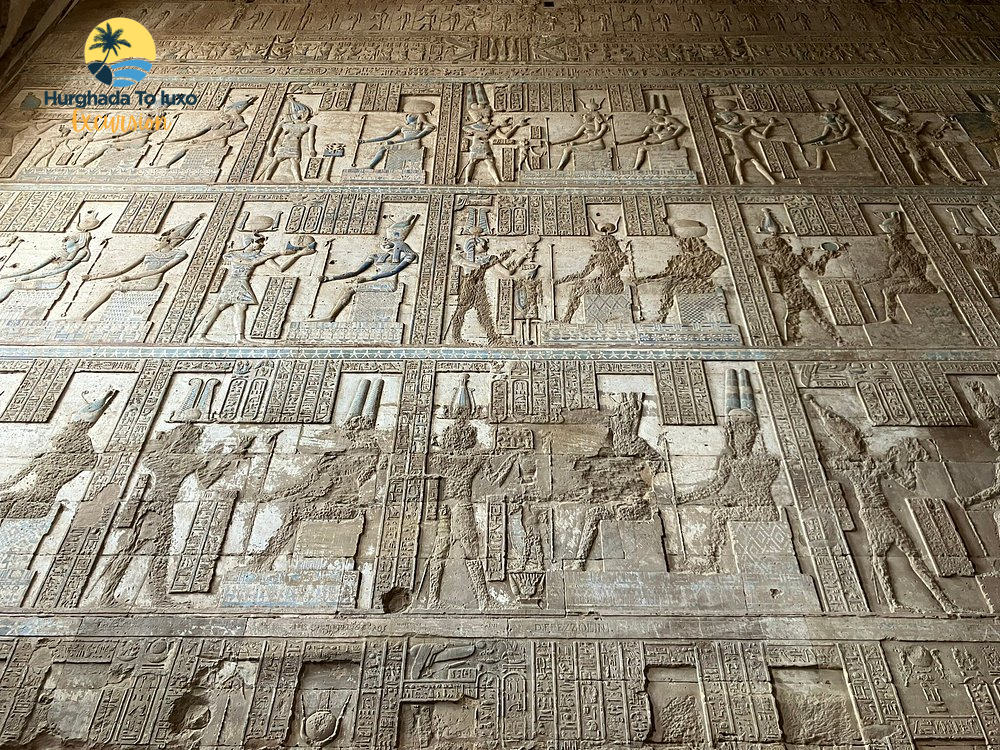
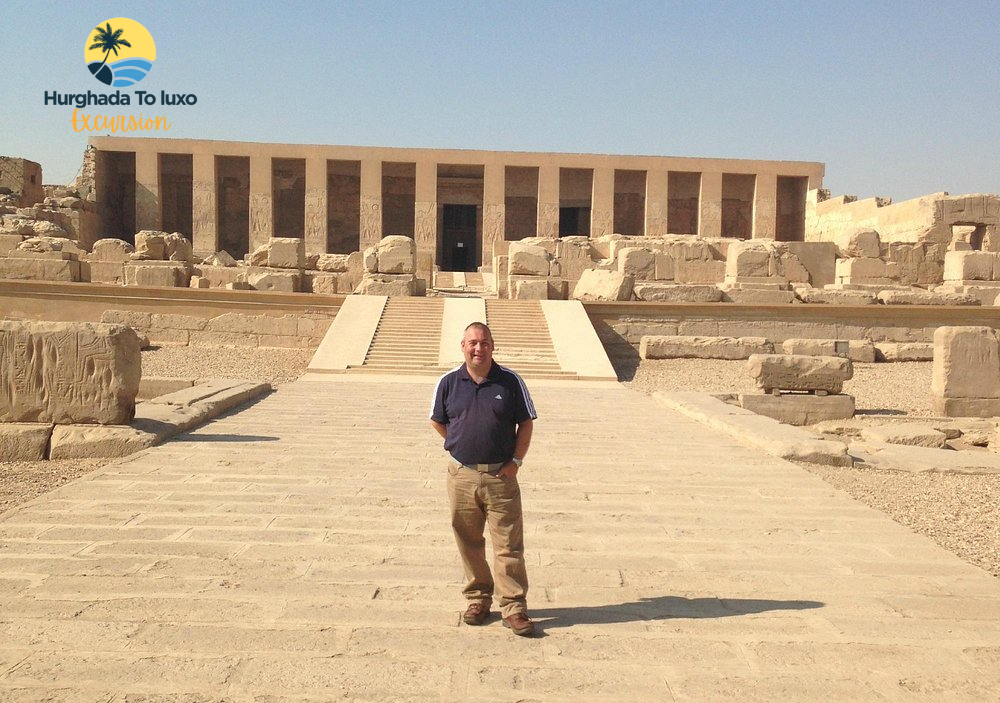
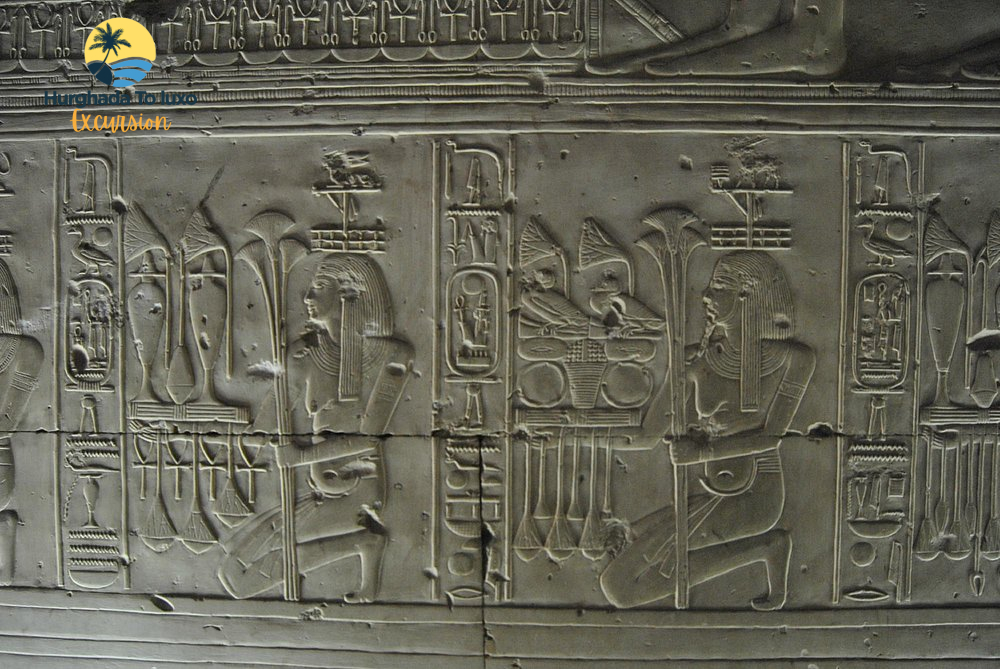
The Temple of Seti I at Abydos is widely considered to contain the finest painted relief art in ancient Egypt — and this is not a subjective assessment but an archaeological consensus. The paintings in the sanctuary corridors, the chapels of Osiris, and the inner halls retain their original colours — deep blues, crisp whites, warm ochres, and precise black outlines — in a condition unmatched by any other New Kingdom painted surface. Seti I died before the temple was completed; his son Ramesses II finished it, and the stylistic difference between their respective sections is clearly legible to any trained guide.
The temple also contains the Abydos King List — a carved register of 76 royal cartouches listing the pharaohs from Menes (the first king of unified Egypt) to Seti I himself, in chronological order. This inscription is one of the most important documents in Egyptology for establishing the royal chronology of pharaonic Egypt.
The Osireion
Behind the Temple of Seti I, accessible by a passage through the complex, lies the Osireion — one of the most enigmatic structures in ancient Egypt. Built to represent the mythological tomb of Osiris, it is a subterranean granite structure partially submerged in groundwater, with a central island surrounded by a channel that symbolises the primordial mound of creation emerging from the waters of chaos. The architecture is deliberately archaic — even at the time of its construction it was designed to appear ancient and primordial, using massive undecorated granite blocks in a style that predates the temple beside it by over a thousand years. Sections of the Amduat and the Book of the Dead are inscribed on its walls.
🌟 Why Abydos is frequently described as the most spiritually resonant site in Egypt: Unlike the grand administrative and political monuments at Luxor and Abu Simbel, Abydos was built specifically as a place where the living could connect with the dead — where the annual Osiris mysteries were enacted, where ordinary Egyptians left memorial stelae hoping to be included in the god’s resurrection, and where the boundary between life and death was considered thinner than anywhere else in the country. This character — ancient, intimate, and genuinely sacred — persists in the physical atmosphere of the site in a way that your guide will articulate and that many travellers describe as uniquely affecting.
Tour Highlights
The Dendera Astronomical Ceiling
The most sophisticated ancient astronomical programme preserved on any Egyptian temple ceiling — the 36 decans, the 12 months, the zodiac copy, and the planetary deities in extraordinary preserved colour. The original zodiac is now in the Louvre; your guide explains exactly what was carved here and why.
The Dendera Crypts
A network of underground crypts accessible through narrow passages in the temple’s outer walls — accessible to virtually no one in antiquity and containing some of the most unusual carvings in Egypt, including the controversial “Dendera lamps” that have attracted alternative archaeology speculation.
The Finest Painted Reliefs in Egypt — Seti I
The sanctuary corridors and chapels of the Temple of Seti I at Abydos retain the best-preserved, most colour-intensive painted reliefs in the country — figures in deep lapislazuli blues, warm ochres, and crisp whites that have barely faded in 3,200 years.
The Abydos King List
A carved register of 76 pharaonic cartouches — the kings of Egypt from Menes to Seti I in chronological order. One of the foundational documents of Egyptology, carved into the wall of a corridor and still legible in its original position today.
The Osireion
The mythological tomb of Osiris — a subterranean granite structure partially filled with groundwater, with a central island surrounded by a symbolically charged channel representing the primordial mound of creation. Deliberately archaic at the time of its construction, still profoundly atmospheric today.
No Crowds — Two Rarely Visited Sites
On a typical day, both Dendera and Abydos receive a fraction of the visitors at Karnak or the Valley of the Kings. Your guide can stop, explain, and allow photographs without the pressure of tour bus traffic. This is what visiting major Egyptian temples felt like before mass tourism.
Temple of Ramesses II at Abydos (Optional)
A short distance from the Seti I temple, the Temple of Ramesses II at Abydos is smaller but contains its own Abydos King List (omitting the same “heretical” rulers as Seti’s list) and well-preserved painted reliefs. Mentioning this add-on at booking allows your guide to allocate time for it.
Optional Qena Overnight — No Rushed Return
An overnight in the Qena area (near Dendera) removes the pressure of a same-day return to Hurghada — allowing full visits at both sites and a relaxed evening before the road north the following morning.
Full Itinerary — Day Trip & Overnight Options
This tour is available in two formats. The itinerary below covers both, starting with the core single-day round-trip programme and then explaining exactly what the optional Qena overnight changes and adds.
Option A — Single Day Round Trip from Hurghada
Duration: Approximately 13–15 hours from pickup to return. Recommended for travellers who want both sites in a single day and are comfortable with a long driving day.
05:00 – 06:00 AM — Pickup at Your Hurghada Hotel
Early departure · Guide on board from departure
Your private, air-conditioned vehicle arrives at your hotel lobby. Your Egyptologist guide is on board from the first moment. Bottled water and USB charging throughout. The early departure is necessary to arrive at Dendera in the cooler morning hours and reach Abydos with adequate visiting time before the return drive.
06:00 – 08:30 AM — Hurghada to Dendera Drive
~230 km west across the Eastern Desert to the Nile Valley
The approximately 2.5-hour drive crosses the Eastern Desert highway and descends into the Nile Valley near Qena. Your guide uses this time to brief you on the Ptolemaic period, the myth of Hathor and her role in the Egyptian religious pantheon, and the specific astronomical content you will see on the ceiling at Dendera.
09:00 – 11:30 AM — Dendera Temple ⭐⭐⭐
The astronomical ceiling · The crypts · The birth house
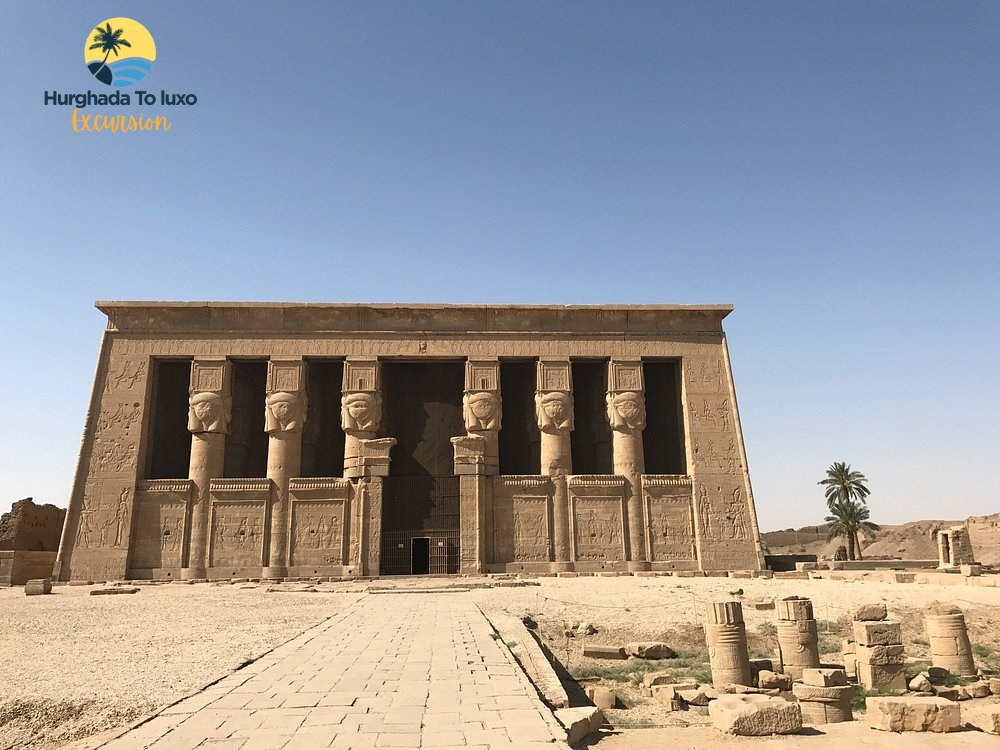
A full 2.5-hour visit to the Temple of Hathor. Your guide leads you through the outer hypostyle hall (with its iconic Hathor-head capitals), into the inner pronaos where the astronomical ceiling fills the entire vault above you in preserved colour, through the sanctuary and offering halls, up to the rooftop chapel (dedicated to the resurrection of Osiris) and the famous circular zodiac chamber, and down into the underground crypts through the narrow wall passages. Throughout, your guide reads and explains the astronomical content of the ceiling in detail — the 36 decans, the seasonal stars, and the original zodiac’s position and significance before its removal to Paris.
12:00 – 13:00 PM — Lunch Near Dendera or En Route to Abydos
A proper break before the Abydos visit
Lunch at a quality restaurant near Dendera or at a convenient point on the 80 km drive south to Abydos. A proper sit-down meal and brief rest before the afternoon programme. Vegetarian, halal, and child-friendly options available.
13:00 – 14:00 PM — Dendera to Abydos Drive
~80 km south through the Nile Valley
The approximately 1-hour drive south from Qena to Abydos (Balyana) follows the western Nile bank through the agricultural valley. Your guide uses this drive to introduce the mythology of Osiris, the significance of Abydos in Egyptian religious geography, and the specific content of the Abydos King List you will see inside the temple.
14:00 – 16:30 PM — Temple of Seti I and the Osireion ⭐⭐⭐
The finest painted reliefs in Egypt · The mythological tomb of Osiris
A full 2.5-hour visit beginning with the Temple of Seti I — the seven chapels (dedicated to Osiris, Isis, Horus, Amun, Ra-Horakhty, Ptah, and Seti himself), the corridor containing the Abydos King List, and the inner sanctuary painted walls that constitute the finest preserved New Kingdom relief painting in existence. Your guide compares the sections completed under Seti I (characterised by a precise, refined hand) with those finished by Ramesses II (bolder, somewhat more rapid) — the stylistic difference is legible to anyone once it is pointed out.
From the temple, your guide leads you through the passage to the Osireion — the subterranean granite structure representing the mythological tomb of Osiris. Partially flooded with groundwater, its central granite island surrounded by the reflective channel, its massive undecorated blocks creating an atmosphere unlike any other structure in Egypt. Approximately 20–30 minutes in the Osireion is a genuinely unusual experience — dark, quiet, and profoundly suggestive of its intended theological meaning.
Your private vehicle drives directly from Abydos northeast across the Eastern Desert back to Hurghada. Approximately 4–5 hours. You arrive at approximately 21:00–22:00 PM, completing a long but extraordinary day at two of Egypt’s most significant and least-visited sites.
Option B — With Optional Qena Overnight
Duration: 2 days / 1 night. Recommended for travellers who want both sites at a fully unhurried pace and prefer to avoid the long same-day return drive from Abydos.
The optional Qena overnight restructures the tour as follows:
Day 1 — Hurghada to Dendera to Abydos to Qena Overnight
Pickup at 06:00–07:00 AM · Dendera Temple (2.5 hrs) · Lunch · Abydos Temple and Osireion (2.5 hrs) · Hotel check-in in Qena area · Dinner at own expense · Overnight in Qena.
Day 2 — Qena to Hurghada (with optional additional sites)
Hotel breakfast · Optional: Temple of Ramesses II at Abydos (30 min if requested) · Optional: Luxor stop en route (discuss at booking — Luxor is approximately 60 km south of Dendera) · Lunch en route · Return drive to Hurghada. Arrival approximately 15:00–16:00 PM (significantly earlier than the same-day return option).
🌙 When the overnight is recommended: If your group includes older travellers, young children, or anyone for whom a 13–15 hour same-day return would be physically demanding — or simply if you want to visit both temples at the most relaxed pace possible without any time pressure — the overnight option is the right choice. The additional cost of one hotel night in the Qena area is modest relative to the overall programme, and the Day 2 return gives you the option to add the Temple of Ramesses II or even a brief Luxor stop that the same-day format cannot accommodate.
Request pricing for the private Abydos and Dendera tour from Hurghada — day trip or overnight format.
✓ Licensed Egyptologist guide — dedicated to your group throughout
✓ Dendera Temple of Hathor entrance (including crypts access)
✓ Temple of Seti I at Abydos entrance (including Osireion)
✓ 1 lunch en route between Dendera and Abydos
✓ Bottled water throughout · Zero shopping stops guaranteed
✅ Additional Inclusions — Overnight Format (Option B)
✓ 1 night hotel in the Qena area (category confirmed at booking)
✓ Hotel breakfast on Day 2
✓ Temple of Ramesses II at Abydos (if requested on Day 2 — entrance included)
❌ What Is Not Included
✕ Dinner on overnight option (at your own expense)
✕ Photography permit inside temples (required for professional/large camera setups — confirm at booking)
✕ Tips for guide and driver (optional — €10–€15 per person appreciated)
✕ Personal purchases and souvenirs
Prices and Booking
Pricing
Price on Request
Price varies by group size, format (day trip or overnight), and travel dates
When contacting us, please specify: group size · preferred dates · day trip or overnight format · any specific interests (Ramesses II temple, astronomical ceiling in detail, etc.)
Your hotel lobby in Hurghada, El Gouna, Sahl Hasheesh, Makadi Bay, or Soma Bay. Your driver meets you with a name board. The Egyptologist guide is on board from this first moment.
Pickup Time — Day Trip
05:00 – 06:00 AM for the single-day round trip, confirmed 24 hours in advance. The early departure is essential to arrive at Dendera before the day heats up and to complete both sites with adequate visiting time.
Pickup Time — Overnight
06:00 – 07:00 AM for the overnight format — a slightly later start is possible as Day 1 ends with a hotel check-in rather than a long return drive.
Return Drop-Off
Day trip: ~21:00–22:00 PM same day. Overnight format: ~15:00–16:00 PM on Day 2. Both door-to-door to your Hurghada hotel.
What to Bring
A Small Torch for the Crypts
The Dendera crypts are electrically lit but the light levels are low and the passages narrow. A small pocket torch or the torch on your phone makes the carvings considerably more visible. This is the single most useful item specific to this tour.
Camera with Strong Low-Light Performance
The astronomical ceiling at Dendera and the painted corridors of the Seti I temple are both indoor subjects in moderate light. A camera capable of high ISO performance without heavy noise will capture the colours far better than a standard phone camera. Flash is not permitted at either site.
Sun Protection
SPF 50 sunscreen, wide-brimmed hat, UV sunglasses. Both temples have significant outdoor areas — forecourts, rooftops at Dendera, and the approach to the Osireion at Abydos. The Eastern Desert heat is considerable in summer months.
Comfortable Closed-Toe Shoes
Both temples involve walking on uneven stone and gravel, and the Dendera crypt passages require crouching and manoeuvring through narrow openings. Closed-toe walking shoes or trainers — not sandals — for both sites.
Modest Clothing — Religious Sites
Both Dendera and Abydos are ancient religious sites requiring covered shoulders and knees. A light, loose layer is ideal — practical for the outdoor heat and appropriate for the temple interiors.
Original Passport
Required at road security checkpoints and at hotel check-in on the overnight option. Keep it in your day bag throughout.
Insider Tips
Tip 1 — Bring a small torch for the Dendera crypts. The carvings in the narrow underground passages are not brilliantly lit, and a pocket torch or phone torch makes an enormous difference to what you can actually see and photograph inside. This is the single most practically useful preparation specific to this tour.
Tip 2 — Ask your guide to explain what the Dendera Zodiac originally showed before it was removed. The circular zodiac carved at Dendera was one of the 19th century’s most significant archaeological discoveries — taken to Paris in 1821 and now in the Louvre. The copy on-site is accurate, but understanding what the original represented, how it was dated, and what it reveals about the exchange of astronomical knowledge between Egyptian and Babylonian cultures is one of the most intellectually rich conversations your guide can have at this site.
Tip 3 — Allow time in the Osireion. Most tours rush through it in 10 minutes. Sitting quietly at the Osireion for 20–30 minutes — listening to the distant sound of the groundwater, looking at the massive granite blocks submerging gradually into the channel — is one of the most genuinely atmospheric experiences in Egyptian archaeology. Your guide can explain the theological reasoning for the deliberate antiquarian architecture while you sit with it.
Tip 4 — The Abydos King List is easy to miss if you don’t know where to look. It is in a corridor off the main temple axis, carved at approximately waist height — not the grand statement you might expect of a document this significant. Your guide takes you directly to it and explains each name, why certain pharaohs were deliberately omitted (the Hyksos, Akhenaten, and the Amarna period rulers are absent), and what the list’s survival means for the chronology of pharaonic Egypt.
Tip 5 — Flash photography is not permitted at either site. The prohibition at the Seti I temple is particularly important — the painted reliefs are among the most delicate surviving painted surfaces in Egypt and are genuinely vulnerable to cumulative light exposure. Follow your guide’s instructions on photography throughout.
Tip 6 — The Dendera rooftop is not to be skipped. The narrow staircase to the rooftop chapel provides a panoramic view over the Nile Valley that contextualises the temple’s setting — flat cultivated land stretching to the desert escarpment in both directions. The rooftop chapel itself contains unusual Osirian imagery distinct from the main temple below.
Tip 7 — Abydos is significantly less visited than Luxor and Dendera. On a typical weekday, you may be the only foreign visitors at the Seti I temple. This quietness — you can stand in a painted corridor with nobody else present — is one of the most distinctive qualities of the Abydos experience and is genuinely unusual in Egyptian tourism today.
Tip 8 — If considering the overnight option, book hotel accommodation in Qena at least 3 weeks in advance. Qena is not a major tourist hub and quality hotels with reliable air conditioning have limited availability. We handle this as part of the overnight booking arrangement.
Frequently Asked Questions
Why are Dendera and Abydos not on most standard Egypt tour itineraries?
Both sites sit between Cairo and Luxor — geographically accessible but not naturally on the itinerary of a Nile cruise (which typically covers Luxor to Aswan) or a Luxor day trip (which focuses on the Theban monuments). From Hurghada, the Eastern Desert crossing gives direct access to this middle Nile Valley region that would otherwise require a detour from either end of the standard tourist circuit. The result is two extraordinary sites that receive a fraction of the visitors of their counterparts further south — which is precisely what makes them worth visiting when the opportunity arises.
What is the Dendera Zodiac and where is the original now?
The Dendera Zodiac was a circular bas-relief carved into the ceiling of a rooftop chapel at Dendera Temple, depicting the Egyptian and Babylonian zodiac constellations in a circular format. Carved approximately 50 BCE, it was one of the most discussed astronomical documents of the 19th century. French engineers removed the original stone from the ceiling in 1821 and transported it to Paris, where it now forms one of the most prized exhibits of the Louvre’s Egyptian collection. A plaster cast copy is displayed in the original position at the temple. Your guide explains the original’s content, the controversy surrounding its removal, and what the circular zodiac tells us about the transmission of astronomical knowledge between Egyptian and Babylonian cultures in the late Ptolemaic period.
Why does the Abydos King List omit some pharaohs?
The Abydos King List, carved under Seti I, deliberately omits several pharaohs considered illegitimate or religiously problematic. These include the Hyksos rulers (foreign kings who occupied northern Egypt during the Second Intermediate Period), the pharaohs of the Amarna period (Akhenaten and his successors, whose monotheistic revolution was subsequently condemned as heretical), and Hatshepsut (the female pharaoh whose reign Thutmose III tried to erase from the record). The omissions are not accidental — the list is a political and theological document as much as a historical one, and understanding what was left out and why is as informative as the 76 names that are included.
Is the single-day round trip manageable or should we always take the overnight?
Both options work well, but they suit different types of traveller. The single-day round trip is approximately 13–15 hours from pickup to return and involves significant driving time (total approximately 620 km round trip). Fit and motivated travellers — particularly those for whom the driving is part of the experience and who are not travelling with young children or older relatives — manage it comfortably. The overnight option is strongly recommended for anyone who wants the most relaxed, unhurried visit at both sites, who prefers to avoid a late-night return drive, or who wants the option of adding the Temple of Ramesses II or a Luxor stop on Day 2. Contact us to discuss your specific group composition and we will advise accordingly.
Can this tour be combined with Luxor?
Yes — Luxor is approximately 60 km south of Dendera, making it straightforward to add Luxor sightseeing to the overnight format. On Day 2, after hotel breakfast and potentially the Temple of Ramesses II at Abydos, a drive to Luxor (Valley of the Kings, Karnak, or both) can be incorporated before the return to Hurghada — creating a comprehensive 2-day programme covering Dendera, Abydos, and Luxor. This extended option adds entrance fees and time but is logistically manageable within the overnight format. Mention this interest when requesting a quote and we will build a specific programme for you.
What is the price of this tour?
Pricing is on request because it varies based on group size, format (day trip or overnight), and travel dates. Contact us at [email protected] or via WhatsApp at +20 100 925 5585 with your group size, preferred dates, and whether you want the day trip or overnight option — we will provide a detailed quote within 24 hours.
Book Your Private Abydos and Dendera Tour from Hurghada
Hurghada → Dendera Temple of Hathor (astronomical ceiling, crypts) → Abydos Temple of Seti I (finest painted reliefs in Egypt, King List, Osireion) → Hurghada. Dedicated Egyptologist guide. Day trip format or optional Qena overnight. All entrance fees included.
Price on Request — contact us with group size, dates, and format preference
The Sky and the Underworld — Two Sites Unlike Any Others in Egypt
What makes the Dendera and Abydos combination genuinely distinctive within the landscape of Egyptian tourism is the contrast it offers. Dendera looks upward — its ceiling is a map of the sky as the ancient Egyptians understood it, a record of astronomical knowledge encoded into painted stone that has survived 2,000 years. Abydos looks downward — into the earth, into the Osireion’s groundwater-flooded granite chamber, into the most sacred and solemn mythology of the ancient Egyptian relationship with death and resurrection. Two temples, two opposing directions, two aspects of the same ancient worldview.
Both are extraordinary. Both are significantly less visited than the Luxor or Aswan monuments. And both are accessible from Hurghada in a single day or a relaxed overnight programme. Contact us with your group size and dates to receive your personalised quote.