👸 Private Tour · Egyptologist Guide · No Shopping Stops
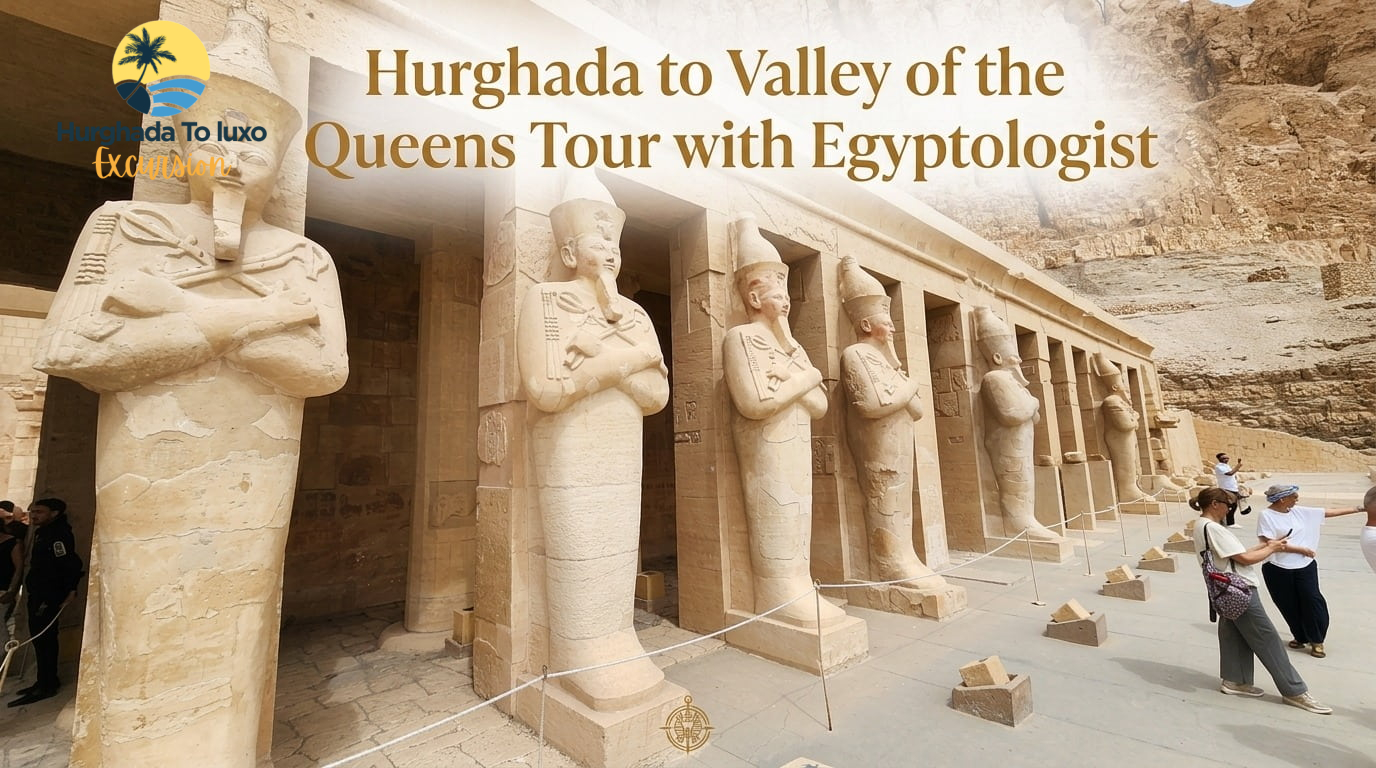
Hurghada to Valley of the Queens Tour with Egyptologist
📅 Updated: June 2026 |
⏱️ 17 min read |
💶 From €95 / person |
⭐ 4.9/5 rated |
👸 Tomb of Nefertari Included
The Hurghada to Valley of the Queens tour with Egyptologist gives you access to one of ancient Egypt’s most breathtaking and least-visited royal burial sites — a place most Hurghada tourists never reach. While the Valley of the Kings attracts tens of thousands of visitors daily, the Valley of the Queens remains quieter, more intimate, and home to what many Egyptologists consider the single most beautiful painted tomb in all of Egypt: the Tomb of Nefertari.
This complete guide answers every question travellers ask before booking: Is the Valley of the Queens worth visiting? Is it worth going to the Valley of the Kings? Can you visit the Valley of the Kings from Hurghada? And crucially — what is the difference between the Valley of Kings and the Valley of Queens, and which should you choose? Whether you are planning a full West Bank day from Hurghada or deciding between the two valleys, this is the most detailed resource available in 2026.
👸 Why the Valley of the Queens is different: The Valley of the Kings contains the tombs of pharaohs — immense, deeply cut, and elaborately decorated. The Valley of the Queens holds the tombs of royal wives, princes, and princesses — smaller in scale but in many cases far more delicately painted. The Tomb of Nefertari, wife of Ramesses II, is decorated with scenes so finely executed that it is known as the Sistine Chapel of ancient Egypt. No group tour from Hurghada routinely includes it. A private tour with a dedicated Egyptologist gives you the full story.
Is the Valley of the Queens Worth Visiting?
Yes — unambiguously. The Valley of the Queens is worth visiting for any traveller interested in ancient Egypt, and for photographers and art lovers it may actually be the more rewarding destination than its famous neighbour. Here is the honest case for visiting.
The Valley of the Queens — known to the ancient Egyptians as Ta Set Neferu, meaning “The Place of Beauty” — contains over 90 tombs cut into the limestone cliffs of the Theban Hills. These were the burial sites of royal wives, daughters, and sons of the New Kingdom pharaohs (approximately 1550–1070 BCE). They are smaller than the royal tombs in the Valley of the Kings, but in many cases the painting quality is significantly higher — because the smaller scale allowed artists to work with greater precision and care.
The Case for Valley of the Queens — 5 Reasons It Is Worth It
🎨
The Sistine Chapel of Egypt
The Tomb of Nefertari (QV66) contains the finest painted walls in ancient Egypt — perhaps in the ancient world. Every surface is covered in scenes so delicate and vivid they were recently described by one restorer as “paintings, not decoration.” This tomb alone justifies the entire journey from Hurghada.
🤫
Far Fewer Crowds
The Valley of the Kings receives 5,000–8,000 visitors per day. The Valley of the Queens receives a fraction of that. On a private tour with an Egyptologist, you will often walk the valley paths with almost no other visitors — an increasingly rare experience at any major Egyptian site.
💎
Exceptional Preservation
Because the Valley of the Queens has received far less visitor traffic than its famous neighbour, the humidity and carbon dioxide damage that has affected some Kings tombs is significantly lower here. The painted surfaces in several tombs retain their original colours with remarkable intensity.
📖
Different Stories to Tell
The Valley of the Kings tells the story of pharaonic power and afterlife theology. The Valley of the Queens tells the story of royal women — their extraordinary status, their relationships, their individual personalities. With an Egyptologist guide, these are some of the most compelling narratives in ancient Egyptian history.
🔑 The honest answer: The Valley of the Queens is absolutely worth visiting — especially if you have already visited the Valley of the Kings. If you have not visited either valley, the ideal programme combines both in a single day (as this tour does): Valley of the Kings in the morning for the royal pharaonic tombs, Valley of the Queens in the afternoon for the exquisite painted royal family tombs. Together they tell the complete story of New Kingdom burial practice that neither valley tells alone.
Is It Worth Going to the Valley of the Kings?
Yes — the Valley of the Kings is one of the most significant archaeological sites on earth, and visiting it properly (with time, a knowledgeable guide, and without being rushed) is one of the defining experiences of any Egypt trip. The question is not whether to visit, but how to visit it well. From Hurghada, a private tour is the only format that allows you to do so.
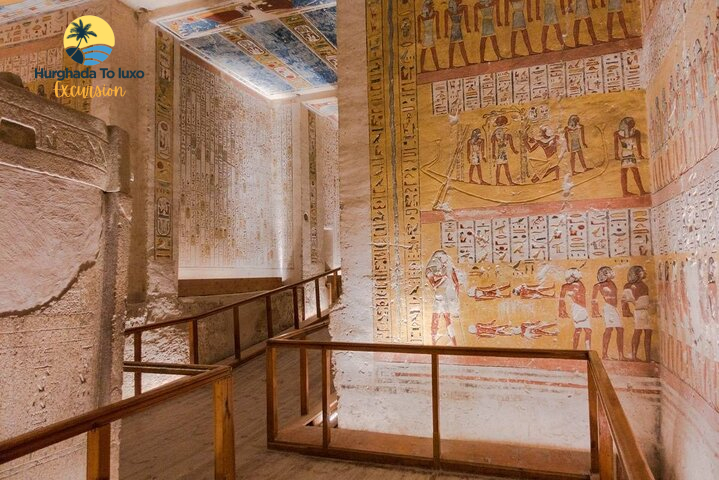
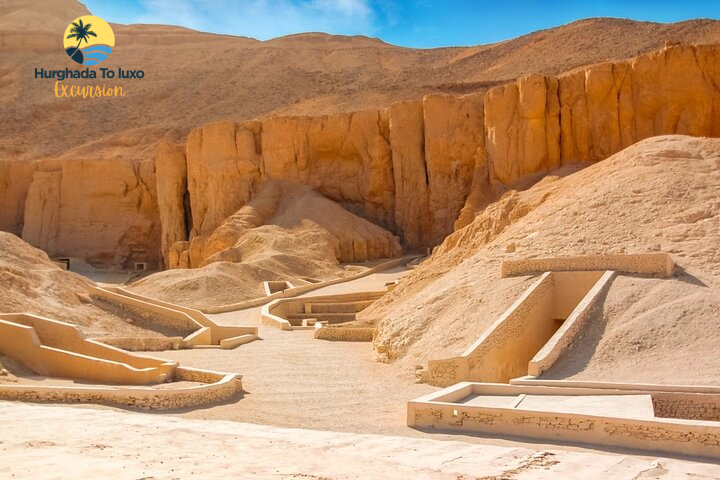
The Valley of the Kings contains 63 tombs dating from 1550 to 1070 BCE — the royal necropolis of the New Kingdom pharaohs, including Tutankhamun, Ramesses II, Ramesses III, Seti I, and Thutmose III. The standard entrance ticket includes 3 tombs selected by your guide. The painted walls — hieroglyphic texts from the Book of the Dead, astronomical ceilings, scenes of the pharaoh’s journey through the Underworld — have survived in extraordinary condition for over 3,000 years.
| Question |
Answer |
| Is it worth visiting? |
Yes — one of the most important archaeological sites on earth |
| Best time to visit from Hurghada? |
Early morning — before 11:00 AM, ideally before 10:00 AM |
| How many tombs can you see? |
3 with standard ticket; Tutankhamun +€15, Ramesses VI +€8, Seti I +€25 |
| How long do you need? |
Minimum 90 minutes; ideally 2–2.5 hours with a dedicated guide |
| Can you photograph inside? |
No photography permitted inside any tomb in the Valley |
| Is it better combined with Valley of Queens? |
Yes — together they tell the complete story of royal Theban burial |
What Is the Difference Between the Valley of Kings and the Valley of Queens?
This is the most commonly asked question by travellers planning a West Bank day from Hurghada — and the answer reveals why visiting both, as this tour does, gives a far richer understanding of ancient Thebes than either site alone. Here is the complete comparison.
| Factor |
Valley of the Kings |
Valley of the Queens |
| Ancient Egyptian name |
Wadi Biban el-Muluk — Gates of the Kings |
Ta Set Neferu — The Place of Beauty |
| Who was buried here? |
Pharaohs of the New Kingdom (1550–1070 BCE) |
Royal wives, daughters, and princes |
| Number of tombs |
63 tombs discovered to date |
Over 90 tombs discovered |
| Tomb size |
Very large — some 100+ metres deep |
Smaller — more intimate scale |
| Painting quality |
Elaborate — grand theological programmes |
Often more refined and delicate |
| Most famous tomb |
KV62 — Tutankhamun |
QV66 — Nefertari (Sistine Chapel of Egypt) |
| Daily visitor numbers |
5,000–8,000 per day |
Much fewer — significantly quieter |
| Photography inside? |
Strictly prohibited |
Strictly prohibited (Nefertari: absolute rule) |
| Nefertari tomb ticket |
N/A |
~€25 extra — strictly limited daily entry |
| Best for |
Royal power, scale, Tutankhamun story |
Royal women, art quality, intimacy, fewer crowds |
💡 The key insight: The Valley of the Kings tells you about pharaonic ideology and power — vast tombs designed to overwhelm. The Valley of the Queens tells you about individual human beings — royal women with names, histories, and personalities that a skilled Egyptologist guide brings vividly to life. The two valleys are 2 km apart. Visiting both in a single day is not only possible from Hurghada — it is the most rewarding West Bank programme available.
Can You Visit the Valley of the Kings and Queens from Hurghada?
Yes — and it is one of the most popular and rewarding excursions available from Hurghada. The drive from Hurghada to Luxor covers approximately 260 km via the Red Sea Mountains highway and takes around 3 hours each way in a modern private vehicle. This is entirely manageable as a day trip — hundreds of travellers make the journey every day of the year.
The key difference between a good experience and an excellent one is the format. Group bus tours from Hurghada typically give you 45 minutes at each major site and include 1–2 shopping stops. A private Hurghada to Valley of the Queens tour with Egyptologist gives you a dedicated licensed guide for the full day, a private vehicle that waits for you alone, and a schedule built around your interests — not the convenience of a 40-person coach.
🚗 Drive Distance
260 km Hurghada to Luxor via desert highway. 3 hours each way in a private air-conditioned vehicle. The desert scenery through the Red Sea Mountains is remarkable in its own right.
⏰ Departure Time
05:00–06:00 AM from Hurghada. Arriving in Luxor at 08:00–09:00 AM. Return departs approximately 17:30 PM, arriving Hurghada 20:30–21:00 PM. A long but entirely manageable day.
🛥️ Nile Crossing
The West Bank (where both valleys are located) requires crossing the Nile. Your tour includes a private motorboat crossing — the same journey Egyptians have made for 4,000 years. Takes approximately 10 minutes.
👨🏫 Private Guide
Your licensed Egyptologist guide is with you from departure in Hurghada, using the 3-hour drive for a private historical briefing before you arrive. The guide stays with you exclusively for the entire day.
10 Highlights of the Hurghada to Valley of the Queens Tour
👸
1. Tomb of Nefertari (QV66)
The undisputed masterpiece of ancient Egyptian wall painting — the Sistine Chapel of antiquity. Every centimetre of the tomb is covered in paintings of extraordinary delicacy and colour, depicting the queen’s journey through the afterlife guided by the gods. Access is strictly limited to protect the paintings.
🤫
2. Tranquillity — Fewer Crowds
While the Valley of the Kings can feel overwhelming with thousands of visitors, the Valley of the Queens is genuinely tranquil. A private tour here feels like it belongs to you alone — the paths between tomb entrances, the limestone silence, the absence of megaphones and tour groups.
👑
3. Valley of the Kings (Morning)
This tour combines both valleys. You visit the Valley of the Kings in the morning — including your choice of 3 pharaonic tombs with the optional addition of Tutankhamun (~€15). Your Egyptologist guide covers the complete story of each tomb’s discovery and significance.
👸
4. Temple of Hatshepsut
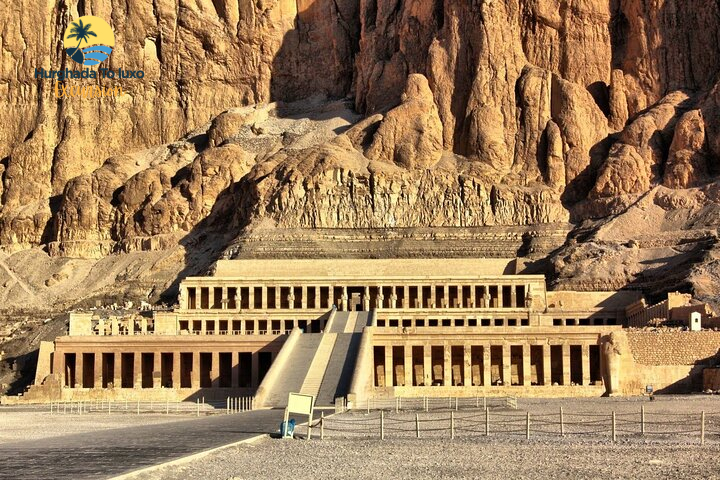
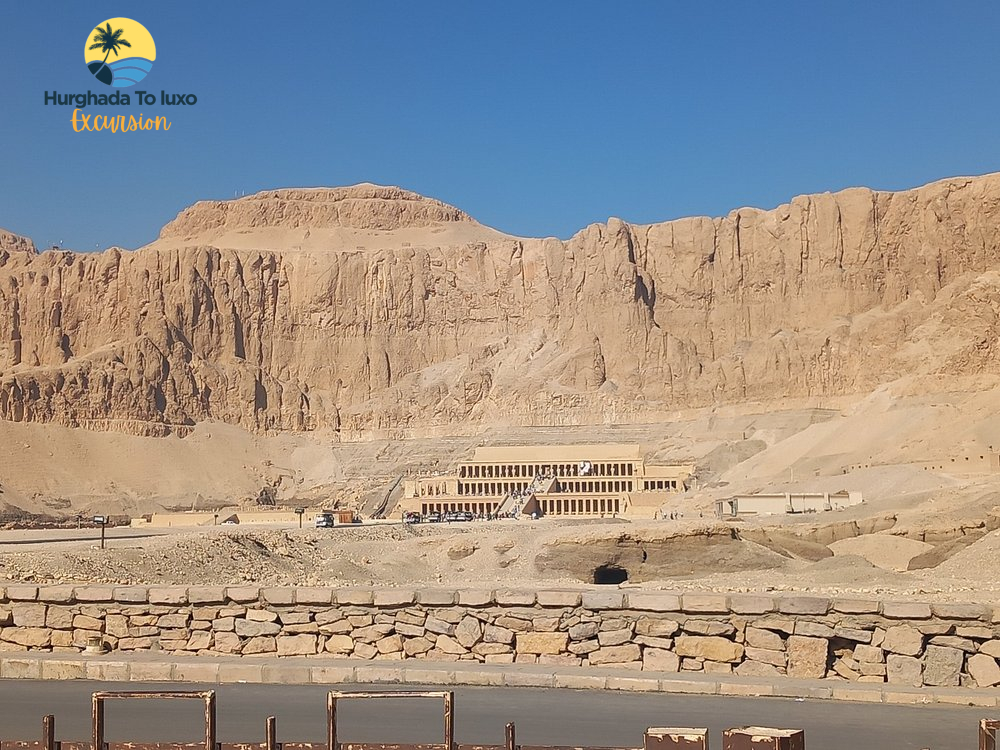
The three-terraced mortuary temple of Egypt’s greatest female pharaoh rises dramatically against the limestone cliffs between the two valleys. Your guide narrates the extraordinary story of Hatshepsut’s 21-year reign and the erasure of her memory by her successor.
🗿
5. Colossi of Memnon
The 18-metre quartzite guardians of the West Bank — first sight on crossing the Nile. In 3,400 years they have survived earthquakes, floods, and the Romans chipping at them for souvenirs. A brief stop that frames the entire West Bank visit with a sense of ancient scale.
🛥️
6. Nile Motorboat Crossing
The private motorboat crossing of the Nile — the boundary between the living city and the necropolis, between East and West, between the rising and setting sun. Your guide explains the cosmological significance of this crossing as you make it.
🏛️
7. Karnak Temple (Optional East Bank)
On the return to the East Bank, an optional visit to Karnak Temple completes the full picture of Luxor. The world’s largest religious complex pairs naturally with the valleys — your guide connects the pharaohs buried on the West Bank to the temples they built on the East.
🍽️
8. Nile-View Lunch
Lunch at a quality Nile-view restaurant between the West Bank programme and any East Bank additions. Egyptian mezze, grilled dishes, fresh juices. Selected by your guide for quality, never for commission. Vegetarian, halal, and child-friendly options always available.
📖
9. Royal Women of Ancient Egypt
Your Egyptologist guide devotes specific time to the stories of the royal women buried in the Valley of the Queens — Nefertari, Tyti, Titi, Ahmose-Nefertari, and others. These are extraordinary biographical narratives that group tours never have time to tell.
🌅
10. Sunset Return Over the Desert
Your private vehicle departs Luxor as the sun sets over the Theban Hills. The Red Sea Mountains turn amber and copper on the return journey. You arrive back in Hurghada by approximately 20:30–21:00, carrying the memory of a remarkable day.
Full Itinerary — Hour by Hour from Hurghada
This is the complete Hurghada to Valley of the Queens tour with Egyptologist programme. Because this is a private tour, the schedule is adjustable to your preferences — mention your priorities at booking and the day is tailored accordingly.
05
05:00 – 06:00 AM — Private Hotel Pickup
Your Private Vehicle Arrives at Your Hotel
Your private, fully air-conditioned vehicle collects you directly from your hotel lobby in Hurghada, El Gouna, Sahl Hasheesh, Makadi Bay, or Soma Bay. Exact pickup time is confirmed 24 hours in advance based on your hotel location. Bottled water and USB charging ports are provided. The driver meets you in the lobby with your name on a board — no searching, no confusion.
⛰️
05:30 – 08:30 AM — Hurghada to Luxor Transfer
The Desert Highway — Private Historical Briefing
The 260 km drive from Hurghada to Luxor crosses the Red Sea Mountains via the desert highway — approximately 3 hours in your private vehicle. Your licensed Egyptologist guide travels with you from departure, using this journey time for a private pre-visit briefing: the history of the New Kingdom, the significance of the West Bank necropolis, the story of Nefertari and why her tomb is considered the finest in Egypt. By the time you arrive at Luxor, you have context that transforms every site you will visit.
🛥️
08:30 – 09:00 AM — Luxor Arrival & Nile Crossing
The Nile at Morning — Crossing to the West Bank
You arrive in Luxor as the morning is fully established. A brief stop before the Nile crossing — your guide orients you to the layout of the West Bank and explains the ancient Egyptian symbolism of the East (land of the living, sunrise) versus the West (land of the dead, sunset). Then a private motorboat crossing of the Nile to the West Bank — the water silver-blue in the morning light with the Theban Hills rising ahead. Your driver meets you on the western shore.
🗿
09:00 – 09:20 AM — Colossi of Memnon
First Sight of the West Bank — The Giant Guardians
The two 18-metre quartzite colossi of Amenhotep III stand at the entrance to the West Bank, the ancient sentinels of the entire necropolis area. They are the first ancient monument you encounter after crossing the Nile — their scale is immediately astonishing. A brief photography stop with your guide explaining their original context: they once stood before the largest mortuary temple ever built in Egypt (now entirely eroded), the entrance to which these colossi guarded.
👑
09:20 – 11:30 AM — Valley of the Kings ⭐⭐⭐
The Royal Necropolis of the Pharaohs
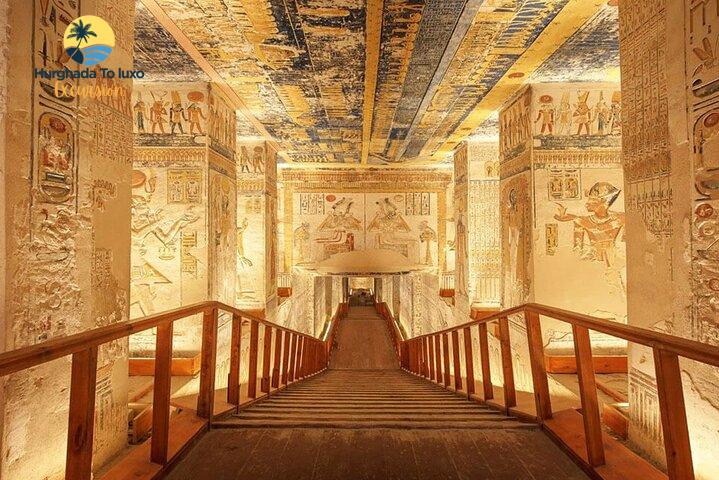
The Valley of the Kings is the first stop on the West Bank — visited in the morning while it is coolest and least crowded. Your standard ticket includes 3 tombs, selected by your guide based on which are open and best preserved on your visit date. The painted corridors and burial chambers — scenes from the Amduat and Book of the Dead, astronomical ceilings, cartouches of the pharaohs — are among the finest painted spaces surviving from any ancient civilisation. Optional: Tutankhamun’s tomb (~€15 extra, highly recommended — the only royal mummy remaining in the valley). Your guide explains the Valley’s history, the role of the tomb-builders who lived in the adjacent village of Deir el-Medina, and the dramatic story of the royal tomb robberies that emptied most tombs within decades of sealing.
👸
11:30 AM – 12:30 PM — Temple of Hatshepsut
Deir el-Bahari — Egypt’s Most Spectacular Mortuary Temple
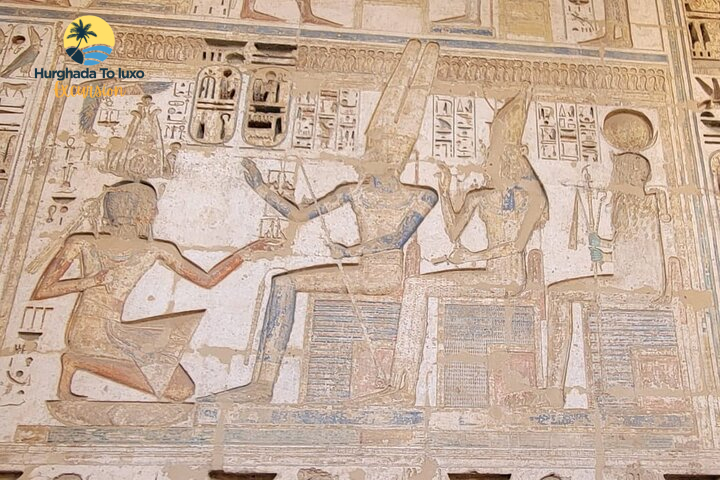
Between the Valley of the Kings and the Valley of the Queens stands the Temple of Hatshepsut — the mortuary temple of Egypt’s most powerful female pharaoh, built around 1479 BCE in three dramatic colonnaded terraces against the sheer face of the limestone cliffs. The architecture is extraordinary and the painted reliefs — depicting Hatshepsut’s divine birth, her expedition to the Land of Punt, and her obelisk erection at Karnak — are among the finest narrative reliefs in Egypt. Your guide narrates the complete story of Hatshepsut’s extraordinary 21-year reign as pharaoh and the political circumstances that led Thutmose III to systematically erase her name from every monument after her death.
👸
12:30 – 14:30 PM — Valley of the Queens ⭐⭐⭐
Ta Set Neferu — The Place of Beauty
The centrepiece of the afternoon and the reason this tour is unique among Hurghada excursions. The Valley of the Queens is 2 km southwest of the
Valley of the Kings — close enough to visit on the same day, but rarely included on standard group tours. You enter a valley that feels genuinely quiet compared to the morning’s Valley of the Kings. Your standard ticket includes 3 tombs in the Valley of the Queens. Your guide leads you through the key open tombs — including QV44 (Prince Khaemwaset, son of Ramesses III), QV55 (Prince Amunherkhepshef), and others depending on the rotation schedule. The highlight is the Tomb of Nefertari (QV66) — accessible for an additional fee of approximately €25 and strictly limited to a small number of visitors per day. If you wish to enter Nefertari’s tomb, this
must be booked in advance — your guide handles the arrangement. Inside, you will see the finest painted tomb in ancient Egypt: every wall a masterwork of delicate brushwork, vivid colour, and theological poetry dedicated to the wife of Ramesses II.
🍽️
14:30 – 16:00 PM — Nile-View Lunch
Rest and Reflect After a Remarkable West Bank Day
After an extraordinary morning and afternoon, lunch at a quality Nile-view restaurant provides a natural rest point. Selected by your guide for quality — never for commission. Egyptian mezze, grilled fish and chicken, fresh salads, cold drinks. Vegetarian, halal, and child-friendly options always available. The Nile terrace, with the West Bank cliffs visible across the water, is a perfect place to process the scale of what you have experienced.
🏛️
16:00 – 17:00 PM — Optional: Karnak Temple
Complete the Picture — East Bank Add-On
For those with remaining energy, a 60-minute visit to Karnak Temple completes the full Luxor picture — connecting the pharaohs buried in the West Bank valleys to the temples they built for worship on the East Bank. At 16:00 the crowds are significantly lower than the morning peak. The afternoon light on the columns and Sacred Lake has its own distinct quality. This add-on is available by request and does not require additional transport.
🚗
17:30 – 20:30 PM — Private Return to Hurghada
Door-to-Door Return as the Desert Turns Gold
Your private vehicle departs Luxor and drives directly to your Hurghada hotel — no shared stops, no coach schedule, no waiting. The 3-hour return drive crosses the Red Sea Mountains at sunset, turning the landscape amber and copper. You arrive back at your hotel at approximately 20:30–21:00 with a full evening ahead and the most rewarding day of your Egypt trip behind you.
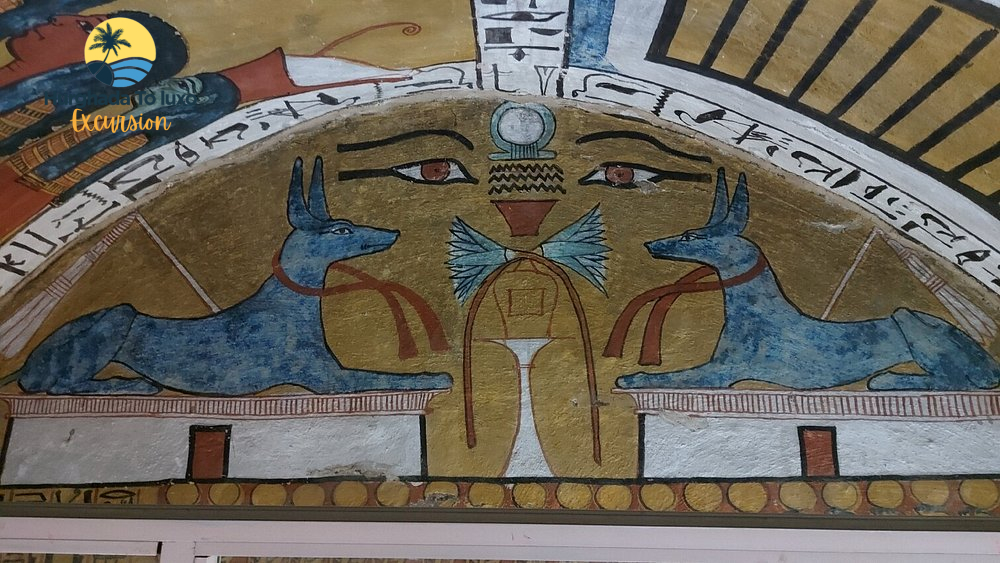
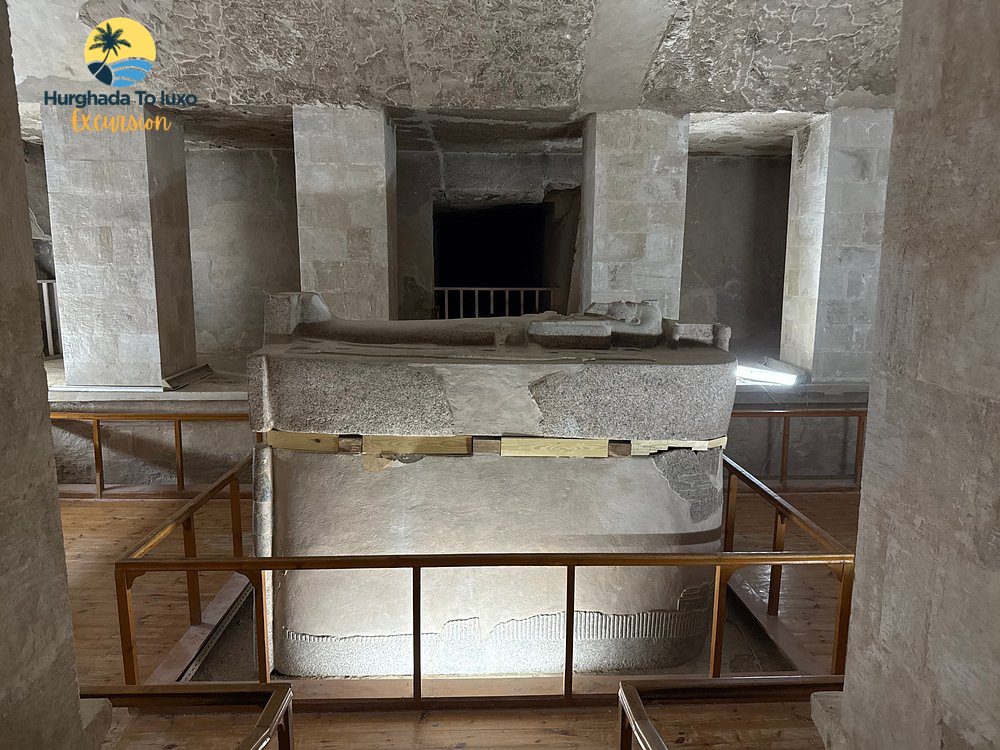
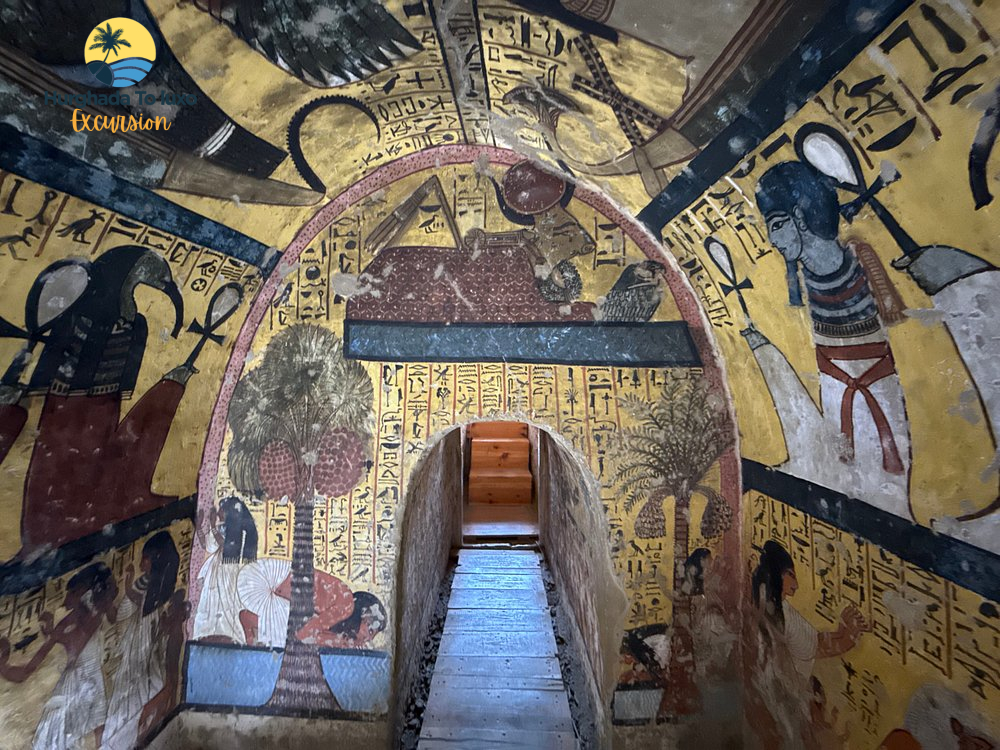
Nefertari Tomb — Strictly Limited Daily Entry
The Tomb of Nefertari allows only a limited number of visitors per day. Secure your private Hurghada to Valley of the Queens tour and we pre-arrange your Nefertari access in advance.
👸 Book Valley of the Queens Tour — From €95
Free cancellation up to 24 hours before departure
Tomb of Nefertari (QV66) — The Complete Guide
The Tomb of Nefertari is the single most important reason to visit the Valley of the Queens — and for many Egyptologists, the single most beautiful painted space surviving from the ancient world. Here is everything you need to know before you visit.
Who Was Nefertari?
Nefertari Meritmut — “Beautiful Companion, Beloved of Mut” — was the Great Royal Wife of Ramesses II, the pharaoh who ruled Egypt for 67 years (1279–1213 BCE) and is believed by many scholars to be the pharaoh of the Exodus. Of his many wives, Nefertari was his favourite — she accompanied him on military campaigns, appeared beside him on temple walls at a scale equal to the pharaoh (unprecedented for a royal wife), and was the subject of the most expensive royal tomb ever built in the Valley of the Queens.
Ramesses II built a temple at Abu Simbel in her honour — the only instance in Egyptian history of a pharaoh building a major temple dedicated to his wife. Her tomb took years to complete and involved the finest artists in the royal workshops. The result is 520 square metres of wall painting that has survived 3,200 years with colours still vibrant enough to have been mistaken for fresh paint by Howard Carter when the tomb was first entered in 1904.
What You See Inside QV66
🎨 The Antechamber
The entrance corridor and antechamber are decorated with scenes from the Book of the Dead — Nefertari playing the game of Senet, the gods greeting her, protective texts. The blue, gold, and ochre palette is immediately breathtaking.
🌟 The Descending Corridor
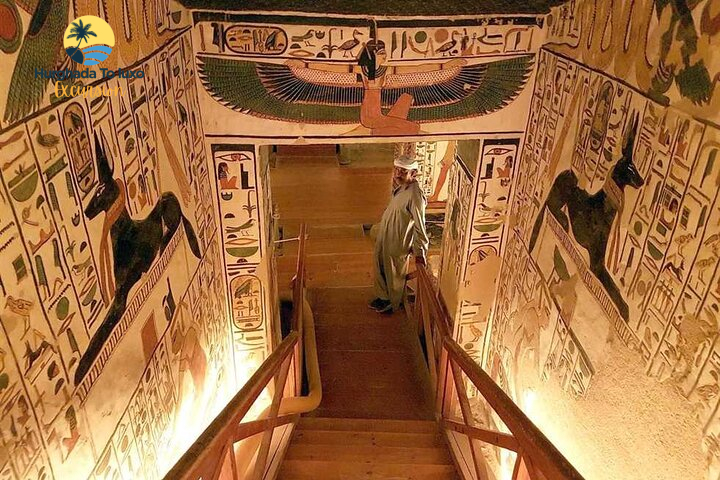
The staircase descending to the burial chamber is lined with scenes of Nefertari being led through the Duat (Underworld) by the gods Isis and Nephthys. The figure of Nefertari — delicate, poised, wearing her white linen dress and vulture crown — is among the finest royal portraits in Egyptian art.
⭐ The Burial Chamber
The crowning achievement of the tomb — a pillared hall whose ceiling is painted as a night sky of golden stars on deep blue, while every wall depicts scenes from the Amduat (Book of the Underworld). The quality of the brushwork is extraordinary even by Egyptian standards.
🦅 The Side Chambers
Four side chambers open off the burial hall, each with its own programme of decoration. The scenes of Ra-Horakhty, Osiris, and the weighing of the heart against the feather of Ma’at are among the most complete and vivid theological programmes in any Egyptian tomb.
| Detail |
Information |
| Tomb designation |
QV66 — Valley of the Queens, Tomb 66 |
| Date of construction |
Reign of Ramesses II — approximately 1255 BCE |
| Discovered |
1904 by Ernesto Schiaparelli (Italian Archaeological Mission) |
| Total painted area |
520 m² of painted wall surface |
| Restoration |
Major Getty Conservation Institute restoration 1986–1992 |
| Daily visitor limit |
Strictly controlled — limited visits per day to protect paintings |
| Additional ticket cost |
~€25 extra per person (must be arranged in advance) |
| Photography inside |
Absolutely prohibited — strict enforcement |
💡 Our recommendation: The Tomb of Nefertari is the single most worthwhile optional extra on any Luxor tour. At ~€25 additional per person, it is more expensive than Tutankhamun’s tomb but arguably more extraordinary — the scale of the painted programme and the quality of the artistry is simply incomparable. If you book this tour, add Nefertari. It must be pre-arranged — tell us when booking and we handle everything.
Key Tombs in the Valley of the Queens
Over 90 tombs have been identified in the Valley of the Queens, of which a rotating selection of approximately 4–6 are open to visitors at any given time. Here are the most significant tombs your guide will prioritise.
QV66 — Nefertari
Great Royal Wife of Ramesses II · ~€25 extra
The finest painted tomb in Egypt. 520 m² of wall painting depicting the queen’s journey through the afterlife. Every surface a masterwork. Limited entry — must be pre-booked. The absolute highlight of any Valley of the Queens visit.
QV44 — Prince Khaemwaset
Son of Ramesses III · Standard ticket
One of the most beautifully preserved prince’s tombs — featuring scenes of the young prince being led by Ramesses III before the gods. The poignant intimacy of a father introducing his son to the divine world makes this one of the most moving tombs in the valley.
QV55 — Prince Amunherkhepshef
Son of Ramesses III · Standard ticket
Another son of Ramesses III — the tomb features bright, well-preserved paintings of the prince in his royal garments. The scenes of father and son moving through the afterlife together are extraordinarily tender by the standards of royal funerary art.
QV52 — Tyti
Royal Wife of Ramesses III · Standard ticket
One of the larger and more elaborately decorated queens’ tombs — with scenes of Tyti being welcomed into the afterlife by the major deities. The ceiling painting of a starry sky and vulture goddess Nekhbet spreading protective wings is particularly fine.
2026 Pricing — Hurghada to Valley of the Queens Tour
Starting from
€95
per adult · approx. £81 per person
✓ Private Vehicle · ✓ All Entrance Fees · ✓ Egyptologist Guide · ✓ Lunch · ✓ Nile Crossing
Children (0–12): €50 · Solo supplement: +25%
What Is Included
✓ Private round-trip air-conditioned vehicle (Hurghada ↔ Luxor) — your group only
✓ Licensed English-speaking Egyptologist guide — dedicated to your group for the full day
✓ Valley of the Queens entrance (3 standard tombs)
✓ Valley of the Kings entrance (3 standard tombs)
✓ Temple of Hatshepsut & Colossi of Memnon
✓ Nile motorboat crossing (West Bank)
✓ 1 lunch at a quality Nile-view restaurant
✓ Bottled water throughout the day
✓ Zero shopping stops — guaranteed
What Is Not Included
✕ Tomb of Nefertari (QV66) — ~€25 extra · must be pre-booked · highly recommended
✕ Tutankhamun’s tomb (Valley of Kings) — ~€15 extra · recommended
✕ Karnak Temple add-on (~€10 extra — optional afternoon visit)
✕ Tips for guide and driver (optional — €10–€15 total appreciated)
✕ Personal purchases and souvenirs
What to Pack — Day Trip Checklist
🧴
Sun Protection
SPF 50 sunscreen, wide-brimmed hat, UV sunglasses. Both valleys are in exposed limestone terrain. The walk between tomb entrances is in direct sun. Reapply every 90 minutes — Luxor UV levels are high year-round.
👟
Comfortable Walking Shoes
The tombs involve steps, uneven stone floors, and sloping descending passages. Closed-toe walking shoes or trainers are essential. You will walk 6–10 km total. No sandals or heels — the Valley paths are rocky gravel.
👗
Modest Breathable Clothing
Shoulders and knees covered at Hatshepsut Temple. Light cotton trousers and a breathable top work throughout the day. Women should carry a light scarf. Pale colours are cooler than dark in the Luxor sun.
💰
Cash in EGP
Egyptian pounds for Tutankhamun’s tomb extra ticket, tips, and small purchases. Approximately £50–£60 equivalent. The Nefertari tomb extra ticket (~€25) is arranged by your guide — confirm payment method at booking. June 2026: £1 ≈ 65 EGP.
📷
Camera (Exterior Only)
Photography is prohibited inside all tombs in both valleys — strictly enforced. However, the exterior landscape, the valley paths, Hatshepsut Temple, and the Colossi of Memnon all photograph magnificently. Bring your camera for everything outside the tombs. A power bank for a full day is essential.
🆔
Passport or ID Copy
Required at security checkpoints en route and at some site ticket offices. The Nefertari tomb booking is sometimes registered by name. Keep it in your bag throughout the day. Your driver handles all highway checkpoint formalities.
10 Insider Tips from Our Egyptologist Guides
Tip 1 — Pre-book the Tomb of Nefertari without exception. The Nefertari tomb has a strictly enforced daily visitor limit. In peak season (October–March) and during Egyptian public holidays, access sells out days in advance. When you book this tour, tell us you want Nefertari and we arrange access in advance. Walk-in access on the day is frequently unavailable.
Tip 2 — Visit the Valley of the Kings before the Valley of the Queens. The standard itinerary does this — Valley of Kings in the morning (cooler, fewer groups) and Valley of Queens in the afternoon (quieter by then as day-trippers head back). This ordering maximises your experience at both sites.
Tip 3 — Do not photograph inside any tomb — not even secretly. Both valleys have guards who will confiscate cameras and phones. The prohibition is not bureaucratic — it protects irreplaceable painted surfaces that camera flash and screen light genuinely damage over time. The Nefertari tomb is especially sensitive; a single breach can result in the tomb being closed. Respect this rule absolutely.
Tip 4 — Ask your guide about the workers’ village of Deir el-Medina. Between the two valleys lies the ancient village of the tomb-builders — the artisans who carved and painted the royal tombs for generations. Their own tombs (a short detour) are among the most beautifully painted in the Theban Necropolis and completely unknown to most visitors. If time permits, ask your guide to include a brief stop.
Tip 5 — The Valley of the Queens path is uneven — take your time. The 200-metre path from the ticket office to the first tomb entrances is on compacted gravel and limestone rubble. It is not difficult but requires care for those with limited mobility. Your guide knows the smoothest route.
Tip 6 — Inside the Nefertari tomb, look up. Most visitors focus on the wall paintings and miss the ceiling — decorated as a midnight blue sky scattered with golden stars, with the vulture goddess Nekhbet spreading her wings protectively above the burial chamber. The ceiling is as carefully painted as the walls and is one of the most beautiful single surfaces in ancient art.
Tip 7 — The princes’ tombs are genuinely moving. The tombs of Princes Khaemwaset and Amunherkhepshef — sons of Ramesses III, both of whom died young — depict Ramesses III leading his sons before the gods in scenes of extraordinary tenderness. The emotional weight of a father commissioning a perfect tomb for a child who died before him reads across 3,200 years without difficulty. Your guide connects this to modern human experience in a way that makes the tombs live.
Tip 8 — The Valley of the Queens is significantly cooler inside the tombs. The limestone tombs maintain a natural temperature of approximately 20–22°C regardless of outside temperature. In summer, this is a dramatic relief after walking the sun-exposed valley paths. In winter, carry a light layer for inside the tombs.
Tip 9 — Allow 20 minutes inside the Nefertari tomb — not 10. Some guides rush the Nefertari tomb to move through the visitor rotation schedule. Your private guide has no such constraint. Ask for a full 20 minutes inside — enough to read the cartouches, identify the individual deities in each scene, and understand the theological narrative from entrance to burial chamber.
Tip 10 — On the return journey, ask your guide about Nefertari’s life. The 3-hour return drive to Hurghada is an excellent opportunity to deepen your understanding of what you saw. Nefertari’s biography — her marriage to Ramesses II, her diplomatic letter-writing to the Hittite queen Puduhepa, her depiction at Abu Simbel — is one of the best-documented stories of any royal woman in the ancient world. Your Egyptologist guide will make the journey disappear.
Real Reviews from Travellers
★★★★★
“The Tomb of Nefertari is the most beautiful thing I have ever seen in my life. I have visited dozens of countries and hundreds of museums. Nothing compares to standing in that painted chamber. Our guide gave us 25 full minutes inside and explained every scene. The Valley of the Queens is completely overshadowed by its famous neighbour and it absolutely should not be.”
Caroline & Michael T. — London, UK · February 2026
★★★★★
“We had done the Valley of the Kings on a previous trip. Adding the Valley of the Queens with a proper guide made it a completely different experience. The princes’ tombs were unexpected highlights — the guide’s explanation of Ramesses III burying his young sons made the paintings mean something that a simple audio guide never could. Zero shopping stops. Highly recommend.”
James R. — Edinburgh, UK · March 2026
★★★★★
“The guide pre-booked the Nefertari tomb as promised and we walked straight in while others were being turned away at the ticket desk. The difference in quality between this private tour and the group tour we did on a previous visit is enormous — the guide, the time at each site, the private vehicle. Worth every penny more.”
Lucy & David H. — Manchester, UK · January 2026
Frequently Asked Questions
Is the Valley of the Queens worth visiting?
Yes — absolutely. The Valley of the Queens contains over 90 royal tombs and is home to the Tomb of Nefertari (QV66), widely considered the finest painted tomb in the ancient world. It is significantly less crowded than the Valley of the Kings, the paintings are often more delicate and well-preserved, and with a dedicated Egyptologist guide the royal women’s stories are some of the most compelling narratives in ancient Egyptian history.
Is it worth going to the Valley of the Kings?
Yes — the Valley of the Kings is one of the most important archaeological sites on earth and visiting it with a dedicated Egyptologist guide is a transformative experience. The standard ticket includes 3 pharaonic tombs. The optional Tutankhamun’s tomb (~€15 extra) is particularly recommended — the only royal mummy still resting in the Valley. The key is visiting properly: with time (minimum 2 hours), a knowledgeable guide, and ideally in the morning before the crowds peak.
What is the difference between the Valley of Kings and the Valley of Queens?
The Valley of the Kings (Wadi Biban el-Muluk) contains 63 tombs of New Kingdom pharaohs — large, deeply cut, and architecturally grand. The Valley of the Queens (Ta Set Neferu — “The Place of Beauty”) contains 90+ tombs of royal wives, daughters, and princes — smaller in scale but often more delicately painted. The Kings valley focuses on pharaonic power and afterlife theology; the Queens valley tells the stories of royal women and children with greater personal and artistic intimacy. Both are on the West Bank of Luxor, approximately 2 km apart, and can be visited on the same day.
Can you visit the Valley of the Kings from Hurghada?
Yes — it is one of the most popular excursions available from Hurghada. The drive covers approximately 260 km via the Red Sea Mountains highway and takes about 3 hours each way. A private tour departing at 05:00–06:00 AM allows a full day at both the Valley of the Kings and Valley of the Queens, with return to Hurghada by approximately 20:30–21:00 PM. Both valleys are on the West Bank of Luxor, requiring a short Nile motorboat crossing (included in your tour).
How do I book the Tomb of Nefertari from Hurghada?
When you book this tour with us, simply mention that you want to include the Tomb of Nefertari. We pre-arrange access as part of your booking — the additional ticket costs approximately €25 per person and entry is strictly limited. Walk-in tickets on the day are frequently unavailable in peak season. Contact us at
[email protected] or WhatsApp +20 100 925 5585 to confirm availability for your date.
Can you take photographs inside the Valley of the Queens tombs?
No. Photography is strictly prohibited inside all tombs in both the Valley of the Kings and the Valley of the Queens. This is a strict preservation rule — camera flash and screen light genuinely damage painted surfaces over time. Guards enforce the rule consistently. The Tomb of Nefertari in particular has absolute zero-tolerance enforcement. Cameras and phones may be taken inside but must remain in bags. Photography is permitted extensively on the exterior valley paths, at Hatshepsut Temple, and at the Colossi of Memnon.
How much does the Hurghada to Valley of the Queens tour cost?
From €95 per adult (approximately £81). Children aged 0–12 pay €50. Solo travellers are subject to a 25% single supplement. Included: private vehicle, Egyptologist guide, Valley of the Queens and Kings entrance (3 tombs each), Hatshepsut Temple, Colossi of Memnon, Nile crossing, lunch, and bottled water. Optional extras: Nefertari tomb (~€25), Tutankhamun (~€15). Zero shopping stops guaranteed.
Is the Valley of the Queens suitable for families and children?
Yes — the Valley of the Queens is excellent for families with children aged 8 and above. The tombs are smaller and less claustrophobic than some in the Valley of the Kings, and the stories of princes and royal children resonate well with younger visitors. The Tomb of Nefertari is appropriate for children of any age who can remain quiet and still. Children aged 0–12 pay €50. The tour departs at 05:00–06:00 AM — manageable for most children who sleep in the vehicle. Child seats available on request.
Book Your Valley of the Queens Tour from Hurghada
Private vehicle, licensed Egyptologist guide, Valley of the Queens & Kings, Hatshepsut Temple, Nile crossing, lunch. Nefertari tomb pre-bookable. Zero shopping stops guaranteed. Free cancellation 24 hours before departure.
👸 Book Now — From €95 Per Person
Final Thoughts — Why the Valley of the Queens Deserves Its Own Day
The Valley of the Queens has long existed in the shadow of its famous neighbour — and this obscurity is one of its greatest gifts to the traveller who makes the effort to visit. While the Valley of the Kings fills with thousands of visitors by mid-morning, the Place of Beauty remains quiet, intimate, and — in the Tomb of Nefertari — home to what may be the single most extraordinary painted space surviving from the ancient world.
A private Hurghada to Valley of the Queens tour with Egyptologist gives you both valleys in a single comprehensive day — the pharaonic grandeur of the Kings’ tombs in the morning and the refined, personal beauty of the royal family’s tombs in the afternoon, connected by the story that only a dedicated licensed guide can tell across both sites.
The ancient Egyptians called this valley Ta Set Neferu — The Place of Beauty. Standing inside Nefertari’s tomb, surrounded by 3,200-year-old paintings of extraordinary delicacy and colour, the name makes perfect sense. Book your tour today and see it for yourself.